



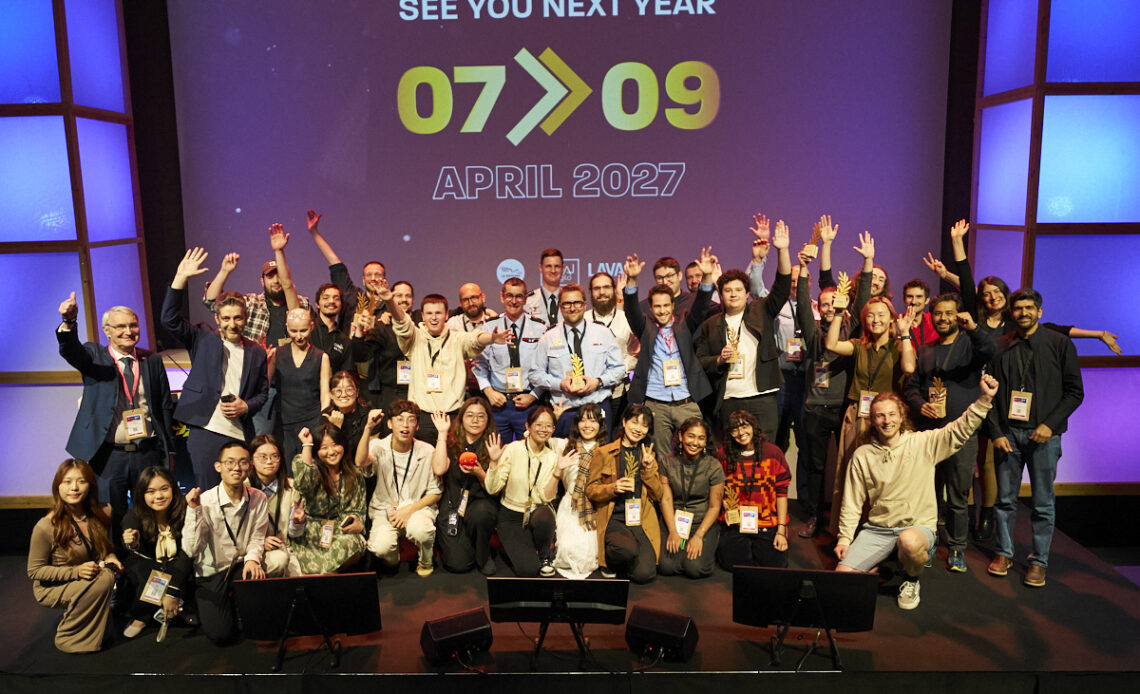
The Laval Virtual Awards Winners
Crédits photos : © Laval Virtual / Prisma
On Thursday 9 April 2026, at the Espace Mayenne, the XR community gathered for the 28th Laval Virtual Awards ceremony. The verdict of an international jury of 70 experts on 300 entries from 30 countries (a record, up 15%) paints a striking picture of an XR industry that is maturing, diversifying and, despite competition from AI, still full of surprises.
The evening was hosted by Naomi Roth, an international keynote speaker specialising in AI and emerging technologies, a pioneer of “VR for Good” in Europe and a former journalist. She conducted on-stage interviews with the winners, weaving together technical questions and broader societal issues.
Since 1999, Laval Virtual has been the world’s leading event for virtual and augmented reality. Three days a year in the capital of the Mayenne, researchers, startups, industry players and artists converge to test, debate and celebrate the best and boldest in the XR ecosystem. The Awards ceremony is its centrepiece: ten trophies presented on stage, each revealing a different facet of a technology that refuses to be pigeonholed.
This 2026 edition was no exception. Laval Virtual’s director, Alexandre Bouchet, set the tone in his opening remarks: the convergence of AI and XR, the growing institutional legitimacy of the sector, and the rise of smart glasses are the three major forces reshaping the landscape. On that last point, he is cautiously optimistic: after decades of unfulfilled promises around mainstream headset adoption, the surge of AI-powered connected glasses may finally change the equation.
The New Generation of XR Talent
#StartUps: PolyFlyx
Sponsored by EDF
The Startup prize goes to PolyFlyx, a young company that won over the jury with an original approach to preserving industrial expertise. Its solution allows experienced operators, some nearing retirement, to delegate physically demanding tasks to a robot while retaining decision-making control. Intelligence stays human; execution becomes mechanical. A hybrid model that captures know-how before it walks out the door.
#ReVolution : WAVY (CEA List)
SIGGRAPH Prize, invitation to exhibit in Los Angeles in July
Research took centre stage with WAVY, developed by CEA List, which wins the trophy in the competition reserved for laboratories. This portable haptic device, originally conceived with an artist exploring the connection with an avatar, can deliver a range of tactile feedback in virtual reality. From gloves to legs to torso, the entire body becomes an interface. Applications range from artistic experience to maxillofacial surgical simulation. The team heads to SIGGRAPH in Los Angeles.
#Experiences : Mirage
The best immersive creation award goes to Mirage, a VR work about depression and anxiety, built as a family project (with her mother and sister) by a director who wanted to find words for what often goes unsaid. Equipped with a haptic vest, the experience places the viewer first in the shoes of someone who doesn’t know how to help, then in those of the person who is suffering. “Parents realised that their words carry a great deal of power,” the creator said on stage. Mirage continues its festival tour, with ambitions to reach schools, counsellors and teachers.
#Students : Ultimate Recycling Super Simulator
Invitation to IVRC in Japan in September
Twenty student projects, eight nationalities, and a winner that built its own device in two weeks. Ultimate Recycling Super Simulator, the student laureate from Arts et Métiers de Laval, is the work of a seven-person team that created an experience that is at once unsettling, funny and disconcerting, with an aesthetic that is “Russian-scientific and a little mad.” The jury praised a physical device that was light, pleasant to the touch, with the Quest controller integrated internally, and a level of finish far beyond what the entry video had suggested.
The General Categories: XR in Service of the Real World
XR Devices & Interactions: KineThreads (Future Interfaces Group / Carnegie Mellon)
The best hardware device prize goes to KineThreads, a force-feedback haptic suit developed by a Carnegie Mellon researcher. Motors at the waist and back drive pulleys connected to all extremities (hands, feet, head) to deliver kinesthetic sensations across the entire body. Where rigid exoskeletons cost thousands of dollars and prove cumbersome, KineThreads weighs under 5 kg, can be put on in under 30 seconds, and costs around $400. The system is open source, available on GitHub. “Alone, I’ll never find the best solution,” explains the professor, who recounts buying twenty different reels of cable to find the right one for his pulley system, eventually settling on a braided fishing nylon rated to 80 pounds.
Developer & Authoring Tools: 2Sync SDK (2Sync GmbH)
Mixed reality still demands too much manual work to transform a physical space into a virtual set. That is the problem 2Sync SDK solves: scan a room, analyse the space, then automatically generate an experience that adapts to any room configuration, like a “second skin over reality.” Founder Moritz Loos, unable to make the trip, accepted his award via video, visibly moved: nominated several times before, this was his first win.
XR for a Cause: Into the Manhole (IDC School of Design, IIT Bombay)
The most emotionally charged prize of the evening. Into the Manhole immerses the viewer in the sewers of India, alongside lower-caste manual scavengers who risk their lives daily, without protective equipment or recourse. Twelve minutes in virtual reality inside a confined, oppressive space, to experience what millions of people live through in India, Pakistan and Bangladesh. The team’s goal: to make the experience freely accessible, including to policymakers. “It is something visible that remains invisible,” the director summed up.
Enterprise & Productivity: JANUS (Institut de Recherche Criminelle de la Gendarmerie Nationale)
The French Gendarmerie takes to the stage with JANUS, a digital twin of crime and accident scenes. Born from the initiative of a gendarmerie officer, developed entirely in-house by four engineers over two years, the software transforms 3D data captured by laser scanner, photogrammetry, LiDAR and GNSS into navigable environments: via VR headset, tablet or smartphone. Jurors, magistrates, lawyers, and even suspects whose traumatic memories need to be reactivated can now step inside the scene. Integrated since September 2025 into the National Judicial Police Unit, JANUS is a 100% sovereign solution. Its presenter, a Laval native, made no secret of his emotion at receiving the award in the very place where, as a child, he had visited the exhibition with wide eyes.
Education & Training: AquaWave Ensemble (LumiSound XRLab, NTHU, Taiwan)
Arriving from Taiwan, AquaWave Ensemble reimagines music education for children and adults alike. In this mixed reality environment with an oceanic aesthetic, students first design their own 3D instruments using AI tools, then import them into a shared space to play in real time, through gesture, alongside their classmates. One student in a VR headset pilots the environment, while others participate via tablet and the headset wearer’s view is projected for the whole class. No prior musical knowledge required, no wrong notes possible. The project has its roots in research conducted ten years ago with autistic children, and has since been deployed from primary school to university level. “We wanted to give them a sense of wonder,” the project lead said.
Consumer Experience & Entertainment: La Magie de l’Opéra (Backlight Studio)
The final trophy of the evening, and perhaps the most dazzling, goes to La Magie de l’Opéra, a 25-minute multi-user experience developed in partnership with the Opéra National de Paris and Vive Arts. The viewer is not a passive observer: they play a chorister about to perform in the Palais Garnier’s new production, on the night when Céleste, a young and promising soprano newly arrived in Paris, decides to flee before taking the stage. They follow her through the wings and across dreamlike worlds inspired by Rusalka, Tosca and Carmen, with characters brought to life through motion capture and the voices of real singers. Produced in four months, the project ran at the Palais Garnier before embarking on a tour of national theatres.
XR is taking root in concrete, socially useful applications: justice, training, inclusion, mental health. It is becoming more accessible on the tools side, with SDKs that reduce the friction of development. And it continues to explore emotional territory that few media can reach: a loved one’s depression, life inside a sewer, a child’s sense of wonder at an instrument.
“Anything that carries a genuine human touch will be valued more, not less,” Naomi Roth, the evening’s host, reminded the audience in her closing remarks. In a sector where generative AI is driving down production costs at speed, that may be the XR industry’s most enduring advantage: intention, empathy, cause. See you from 7 to 9 April 2027 for the 29th edition.

