



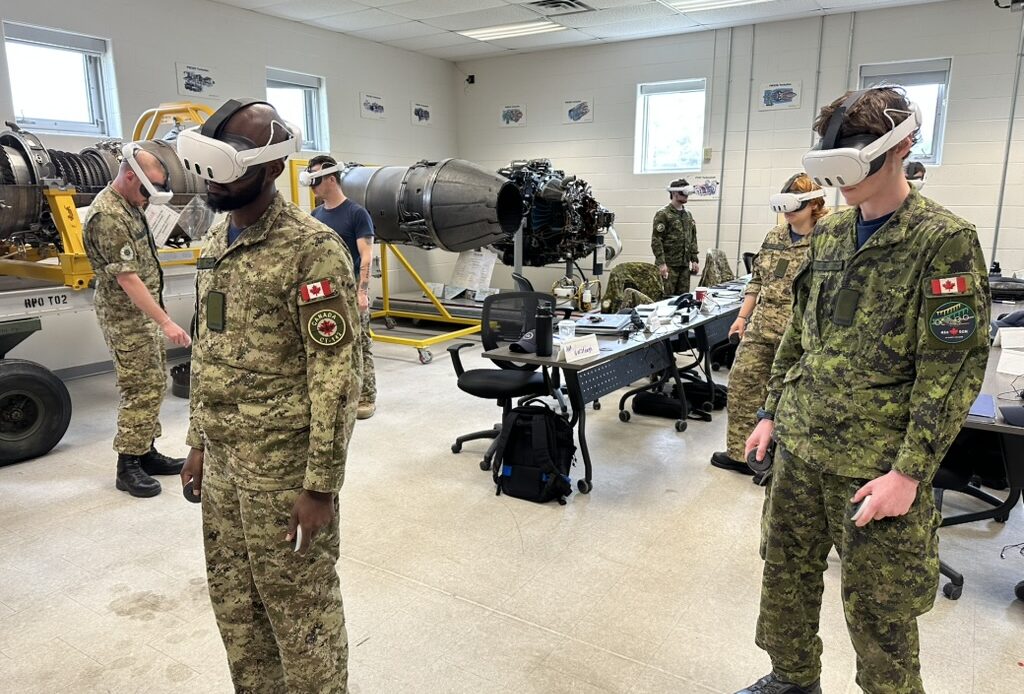
OVA is working with the Canadian Armed Forces to develop immersive training scenarios using AI.
Crédits photos : OVA
Artificial intelligence has become a part of our everyday lives. But it has been making inroads into the immersive technology sector for years. AI enables real-time adjustments during virtual reality experiences. This is particularly valuable in training scenarios. The company OVA offers spatial computing solutions that use AI to create and deploy immersive content. It has also designed a conversational agent, directly integrated into its platform, to guide learners through the training process. Founder and CEO Harold Dumur talks to us about StellarX and OVA’s plans for the Laval Virtual exhibition.
Can you introduce your company?
Founded in 2014, OVA develops AI-enabled spatial technologies that democratize the creation and deployment of virtual and mixed reality experiences. Its core platform, StellarX, allows organizations to build and modify immersive environments without complex coding, reducing the time and cost traditionally associated with XR production. OVA’s technology supports high-stakes government, commercial, and defence training and operations where precision, adaptability, and measurable outcomes are critical.
Beyond the platform itself, OVA works closely with enterprise and public-sector partners to design pedagogy-driven immersive experiences. The team brings together AI specialists, 3D artists, instructional designers, and immersive technologists to help organizations operationalize spatial computing in ways that align with real-world performance, safety, and knowledge-transfer objectives.
What are you presenting at Laval Virtual exhibition?
We will be showcasing our industrial use cases, specifically, our work with ArcelorMittal to make steelwork training safer and unlocking previous training constraints through the use of AI-enabled VR. Our booth will be presented with Arcelormittal. This is an exclusive and rare opportunity for visitors to learn from both the client and creator, to understand how these experiences are built, learnings, impact, and more.
Are you planning any activities ou demos for visitors?
We will be providing demos of StellarX, which includes a demo of AgentX, our conversational AI Agent embedded inside StellarX that can complement instruction, coach, guide, and test users.
Can you explain the role of artificial intelligence for the innovation you developed?
OVA’s current innovation focus is AgentX, an AI-native interaction framework embedded directly into the StellarX immersive platform. AgentX introduces autonomous, context-aware agents into spatial environments. Unlike traditional pre-scripted XR experiences, these agents will be able to interpret user actions, spatial position, object interactions, and scenario state in real time, generating adaptive responses based on both domain-specific knowledge and the evolving context of the experience.
From an innovation standpoint, AgentX explores the convergence of large language models, structured knowledge bases, and spatial computing. The objective is to move beyond static immersive content toward adaptive, behaviorally dynamic environments where AI agents can simulate expertise, decision-making, and human interaction within defined operational and ethical constraints.
What benefits do your solutions bring to the training sector?
In the defence and industrial sectors, our technology is helping organizations modernize training and safety practices by dramatically changing how people learn and internalize complex tasks. For example, with the Canadian Forces School of Aerospace Technology and Engineering (CFSATE), we deployed AI-assisted, fully interactive VR modules that let trainees explore and manipulate a digital twin of a jet engine, visualize internal processes, and get contextual help from an AI agent, reducing what used to take a day of instruction down to minutes while improving individual comprehension and self-paced progression.
In industry, we’re advancing similar goals with the WorkSafe AI project, funded through Canada’s AI Supercluster in partnership with ArcelorMittal and research collaborators. This initiative blends AI, immersive scenarios, and predictive risk assessment to enhance steel-manufacturing safety training, aiming to reduce workplace injuries and set new standards for industrial safety education.
By coupling real-world operations with adaptive immersive training, we’re helping sectors where risk and complexity are high to build competency more efficiently and with better outcomes.