



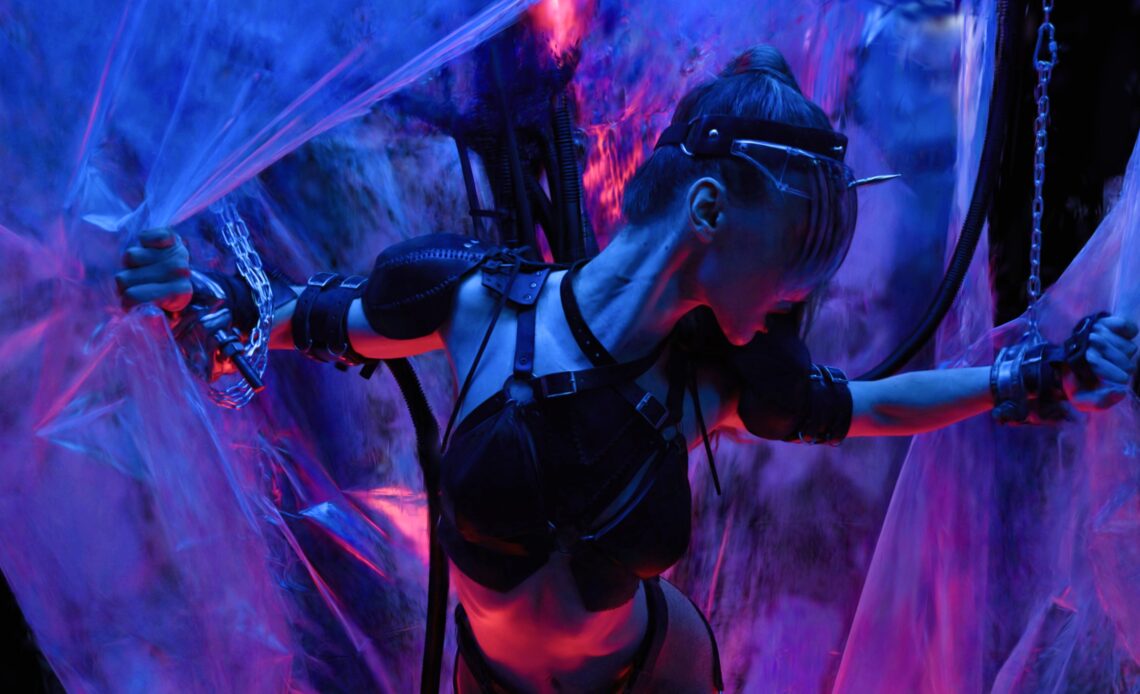
Gracia aims to make volumetric capture and the streaming of photorealistic videos more accessible.
Crédits photos : Gracia
When creating immersive experiences, video capture and realistic rendering are essential criteria. This is where photorealistic volumetric capture comes into play, enabling the reproduction of images of the real world within a virtual environment. However, processing and deploying these videos typically requires heavy software. Gracia aims to simplify both the capture and streaming of volumetric videos, notably through the use of 4D Gaussian Splatting technology. We spoke with Georgii Vysotskii, CEO and co-founder.
Can you describe your company?
Gracia is a London-based startup building the world’s first end-to-end infrastructure for producing and distributing photorealistic volumetric video using 4D Gaussian Splatting (4DGS). Our solution could be used in XR, VFX, Computer Graphics, and Creative Industries, enabling a wide range of applications such as location scouting for film productions using Gaussian Splatting, immersive entertainment and experiences, volumetric masterclasses, virtual performances, and much more. 4D Gaussian Splatting—a breakthrough technology that allows for the reconstruction of real-world objects and scenes with photographic fidelity and exploration in XR.
We provide an end-to-end pipeline including cloud-accelerated processing, a studio environment for editing, Unity and Unreal Engine plugins, and a distribution system for the 4DGS content. The company (Gracia) was founded in 2023 by me and Andrey Volodin, CTO and Co-Founder.
Are you planning any exclusive features for our visitors?
At Laval Virtual, we are showcasing our most significant update yet: WebXR support combined with streaming for volumetric video. This is a major milestone that transforms volumetric media from heavy, isolated files into an accessible web-native format.
Key highlights include WebXR and WebGPU, and the ability to view photorealistic 4D video directly in a browser (on headsets, smartphones, or laptops) without needing to download a native application. We have also achieved a transmission rate of 75 Mbps (approximately 500MB per minute of video streaming), bringing high-fidelity volumetric content within the reach of consumer-level bandwidth. And we provide updated tools for seamless integration of 4DGS into Unity and Unreal Engine workflows.
At our booth, visitors will be able to experience content across devices. We will demonstrate how our volumetric video runs on standalone headsets, as well as via PCVR. There will also be web-based Demo. Visitors can see the instant launch of 4D scenes through a web browser to experience the ease of distribution firsthand.
How do you focus on innovation at Gracia?
From an innovation perspective, we are solving three fundamental challenges that held back volumetric media: temporal consistency, compression and rendering, and reducing capture complexity.
Unlike “flipbook” approaches where frames are trained separately, we train frames together in overlapping batches. This ensures there is no flickering and allows for “infinite” frame interpolation (e.g., playing 30 FPS captured footage at 90 FPS smoothly).
Since day one, we have achieved a 100× reduction in data size, bringing it down from 100 GB/min to approximately 1 GB/min. We are now further optimizing these files to 75 Mbps to enable seamless streaming. This efficiency directly supports our breakthrough in real-time rendering on standalone headsets — a challenge we are very proud to have solved. We can now render up to half a million splats per frame on devices starting from Quest 3 at 72 FPS, ensuring a smooth experience with no motion sickness.
At last, our current focus is on reducing the number of cameras required for high-quality capture and making the technology accessible to a wider range of creators.
Does your solution help to transform different fields of activity?
Volumetric video was restricted by studio-bound capture, massive file sizes, and poor performance. Gracia is transforming it into a practical infrastructure comparable to traditional streaming video. There are multiple concrete applications.
In education and sports, 4DGS content in virtual and augmented reality allows for the high-precision delivery of complex learning techniques in fields like sports, cooking, and crafting. Users have the ability to pause the video and examine the lesson from any angle, providing a complete spatial understanding of the process.
For the VFX & Film industry, we allow studios to integrate photorealistic volumetric performances that maintain perfect actor likeness and lighting, bypassing the labor of traditional digi-doubles and enabling complete creative reframing in post-production.
In fashion, we powered a 4DGS runway show (Karl Kani), where viewers could examine clothing textures and model movement from any angle with photographic realism. And for the entertainment sector, our technology is powering an experience at one of the major European theme parks.