


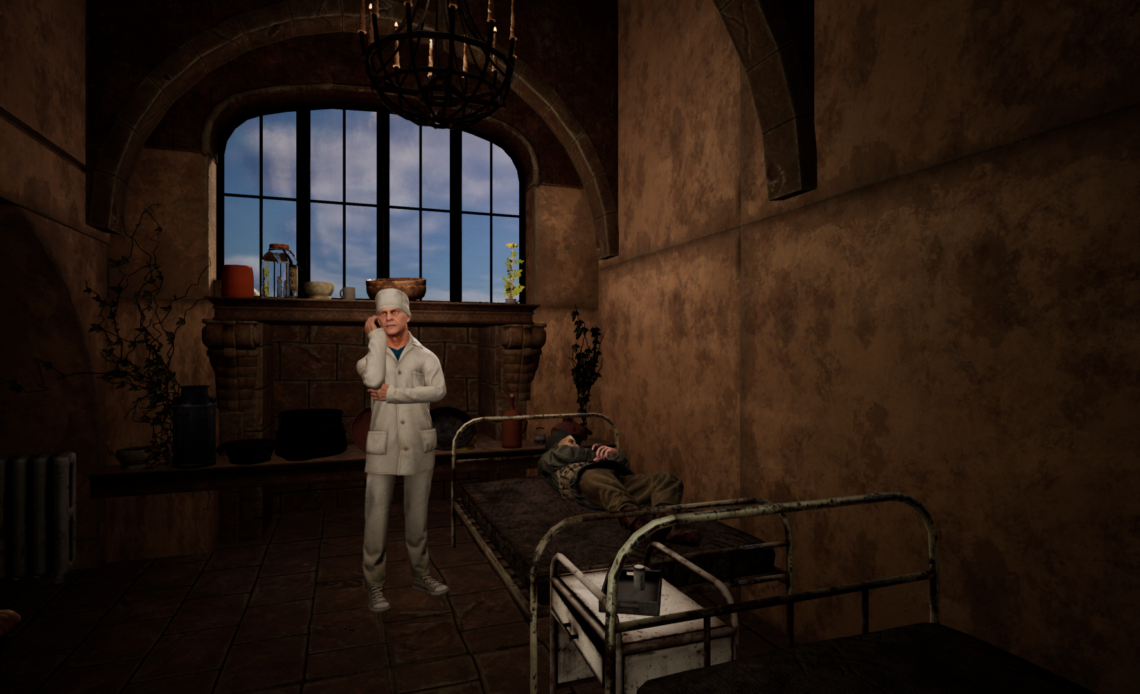
Digital Poupre Studio uses generative AI to develop immersive, evolving cultural experiences.
Crédits photos : Digital Poupre Studio
Artificial intelligence has a lot to offer the immersive world. For industry players, the key challenge is to enable more adaptive immersive experiences that adjust in real time. That is why they are particularly interested in generative AI and human-machine interactions. Digital Pourpre Studio’s mission is to create virtual reality experiences that are intelligent and scalable, and that can benefit the cultural and heritage sectors. We spoke with Romain Giovannini, CEO.
What does Digital Pourpre Studio do?
Digital Pourpre Studio is an immersive technology studio specializing in real-time 3D, virtual reality, and interactive simulations. Our mission is to turn complex ideas into powerful immersive experiences that create impact, understanding, and engagement.
We help companies virtualize complex systems and transform them into engaging, immersive experiences. Our solutions are used for training, simulation, digital twins, experiential marketing, and the recreation of environments that are inaccessible, hazardous, or no longer existing.
Founded in March 2022, the studio was initially created to develop our VR game Arise from Shadows. This project allowed us to build strong expertise in real-time development using Unreal Engine 5 (4 at that time), high-end rendering, and interactive design.
Since October 2024, we have expanded our activities to provide immersive solutions and development services to external clients. Today, more than seven companies trust us to design and develop custom XR or 3D experiences tailored to their business challenges.
What are you preparing for the Laval Virtual exhibition?
We will showcase an immersive demonstration experience developed with Unreal Engine 5. This experience is designed as a modular proof-of-concept for cultural and heritage institutions (castles, museums, historical sites), illustrating how immersive technologies can enhance storytelling and audience engagement.
This showcase is a framework designed to illustrate how real-time 3D and VR can be adapted to cultural mediation, educational experiences, and heritage enhancement projects. This experience was initially developed in response to a client brief, addressing specific needs in cultural mediation and audience engagement.
What are you offering at your booth?
Due to booth configuration, the experience will be presented in a curated format through video sequences and live explanations of the interaction design and production workflow.
We will also be available for scheduled meetings to discuss specific project needs and immersive strategy development.
In what ways are you innovating with generative AI?
Rather than using AI as a simple dialogue tool, we are developing a system where LLM-driven characters actively participate in a social deduction gameplay structure. Players must identify deception, defend themselves, and strategically influence other characters whose behavior is dynamically generated through language-based reasoning models.
Our objective is to explore how generative AI can move from a supporting feature to a central systemic mechanic, enabling dynamic storytelling and adaptive interaction models. The objective is not only to develop a game, but to design and test a modular dialogue architecture that can later be integrated into immersive experiences for professional and institutional use cases – such as training simulations, interactive mediation, or decision-making scenarios.
This R&D approach allows us to explore the limits of AI-driven interaction while building transferable technological frameworks for future immersive solutions.
How do you plan to transform the immersive sector in the cultural world?
In the sector of XR development for cultural and industry, many immersive experiences remain either highly technical demonstrations or linear, passive narrative formats. While visually impressive, they often lack adaptive interaction and long-term engagement potential.
Our approach contributes to transforming the field by combining real-time 3D environments (Unreal Engine 5), interactive design, and AI-driven systems to create structured yet dynamic immersive experiences.
Rather than building fixed experiences, we design modular frameworks that can evolve, be customized, and adapt to different contexts — whether for museums, heritage sites, training simulations, or experiential installations.
For example, our cultural demonstrator illustrates how immersive storytelling can shift from passive observation to active participation through interaction mechanics. Our research on LLM-driven dialogue systems explores how AI can introduce adaptive conversational layers in immersive environments, enabling more responsive training or mediation scenarios.
By treating immersive projects as evolving systems rather than static content, we aim to move the sector toward scalable, intelligent, and reusable immersive solutions.