


The Cintoo platform transforms data into immersive environments for the construction industry.
Crédits photos : Cintoo
In this era of digital transformation, industrial companies must leverage growing volumes of data from laser scans, BIM, and the IoT. Still too complex, this data often remains underutilized. Cintoo offers an innovative solution with its cloud platform dedicated to reality capture. By combining high-fidelity 3D visualization and virtual reality, it transforms this data into immersive, actionable environments. This represents a major breakthrough for better understanding, collaboration, and informed decision-making in key sectors such as manufacturing, energy, and construction. We spoke with Dace Campbell, Product & Business Manager, XR & Metaverse at Cintoo.
Can you present Cintoo?
Cintoo is a cloud-based reality capture platform that enables organizations to fully leverage their scan data by connecting laser scans, BIM, and other digital assets/IoT into a single, scalable environment. Founded in 2018, Cintoo helps industrial and construction teams turn complex reality data into actionable insight by making it accessible across workflows. Through its cloud-based platform, Cintoo streams high‑fidelity, mesh-based scan data allowing users to navigate, act on and share their virtual environments, enabling a reference source of truth for all stakeholders.
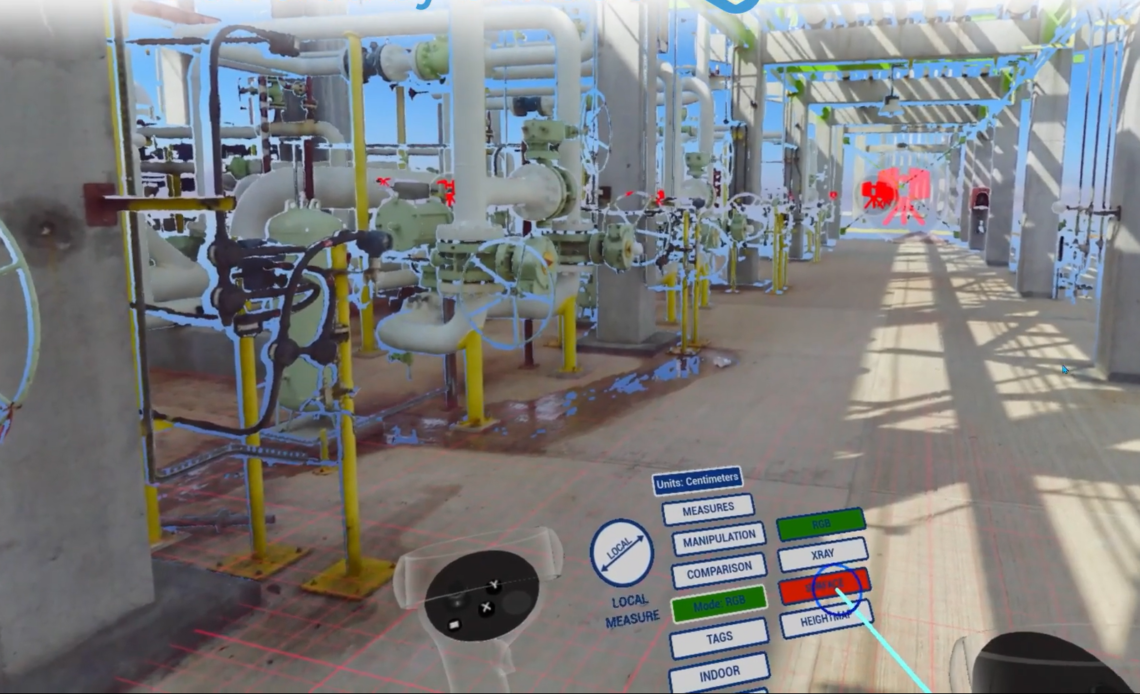
Using a hybrid rendering approach that combines static and streamed mesh, Cintoo preserves the full richness of laser scan data while making it accessible in immersive VR at a true 1:1 scale. Users can navigate scanned facilities, interact with mesh and BIM data, and move seamlessly between detailed inspection views and larger contextual perspectives. This allows teams to better understand complex spaces, collaborate more effectively, and make confident, data-driven decisions.
Can you tell us more about the platform you developed?
Cintoo is a leading industrial metaverse platform that enables organizations to experience, analyze, and collaborate on reality capture data directly in virtual reality. At the core of Cintoo’s offering is mesh-based streaming technology, which makes it possible to stream massive, high‑fidelity scan data as optimized 3D meshes into VR headsets without sacrificing accuracy or detail. Users can explore facilities and assets at a true 1:1 scale, interact with scan and BIM data, and make informed decisions inside an immersive environment designed for real-world industrial workflows.
Built on Unreal Engine and cloud-connected, the Cintoo VR Experience transforms laser scans into interactive VR experiences that run across a wide range of PCVR headsets and immersive environments, including room-scale solutions like Igloo. Cintoo preserves the richness of original scan data while dynamically adapting levels of detail as users move, teleport, or zoom through complex spaces. The result is a flexible, device-agnostic VR platform that scales collaboration, enhances understanding, and brings reality data to life across the industrial metaverse.
In Laval Virtual, Cintoo will be demonstrating our industrial metaverse platform solutions, featuring the immersive Cintoo VR Experience app and our web app, both of which allow you to seamlessly navigate through streamed, high-fidelity reality capture data in real time.
What innovation does Cintoo rely on?
Cintoo’s current innovation centers on advancing how large-scale reality capture data can be technically accessed, rendered, and interacted with in immersive environments. The core project driving this innovation is the development of a hybrid mesh-based streaming architecture that enables massive laser scan datasets to be explored in VR at full 1:1 scale, both egocentrically and exocentrically, without requiring local data decimation or manual optimization.
From an innovation standpoint, the key challenge Cintoo is addressing is the inherent mismatch between the size and density of industrial scan data and the performance constraints of real-time VR. Cintoo’s platform mitigates this by converting point cloud data into optimized 3D meshes and dynamically combining static and streamed mesh rendering. This system continuously adapts the level of detail based on user position, scale, and movement whether the user is inspecting fine details at human scale or zooming out to understand spatial relationships across an entire facility.
Another active area of innovation is device-agnostic XR delivery. Through its Streaming SDK and Unreal Engine–based VR Experience, Cintoo is developing a flexible infrastructure that supports multiple VR headsets and room-scale immersive environments, such as those offered by Igloo, from the same underlying data model. This work focuses on interoperability and allows users to collaborate through immersion. Particularly due to the Igloo partnersip, the solution offers an innovative way for users to collaborate within a VR-simulated room environment.
Cintoo is also currently working on extending and connecting VR experiences, to foster real-time collaboration in VR and the desktop. When we deliver this capability, it will be the only solution available in the market that offers a multi-participant, immersive experience of high-fidelity scan data. Overall, Cintoo’s current innovation is not about creating virtual worlds, but about making real-world, high-fidelity spatial data computationally usable in VR at scale, with accuracy preserved, and in a way that supports engineering, operations, and decision-making workflows grounded in reality.
Which sectors do Cintoo’s solutions target, and how do you help them?
Cintoo’s solutions solve problems for professionals in multiple industries, including AEC, energy, and manufacturing. In particular, our Cintoo VR Experience app supports enterprise use cases including design review, simulations, and training.
For example, in the energy industry, our oil and gas customers are using the Cintoo VR Experience in a couple ways. One customer is developing operational training for their staff, so that they can get virtual tours and training in a controlled environment, rather than risk safety and comfort in outside in the winter. Another has recognized that the cost benefit of scanning an off-shore oil rig and sharing that data set from the field to engineering offices across the globe is significantly cheaper than the tens of thousands of euros it costs per flight to bring engineers out to the off-shore facility to problem-solve.
Additionally, in manufacturing, our customers rely on facility scan data in VR to design and confirm the fit of assets within a shop, to eliminate waste and minimize downtime when retooling an assembly line. These manufacturers, from automotive to aerospace, also leverage VR for full-scale, immersive simulations, to test anything from ergonomics during assembly to minimizing exposure to risky environmental conditions.
Across multiple industries, Cintoo customers are finding significant savings by harnessing the industrial metaverse, building spatial and immersive experiences of high-fidelity scan data to make more effective business decisions.