



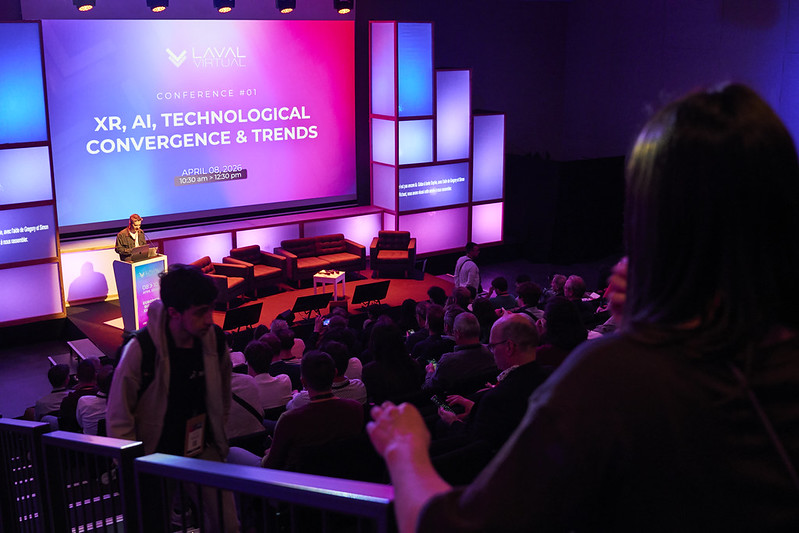
Crédits photos : © Laval Virtual / Prisma
Summary of the first morning conference session of the 28th edition of Laval Virtual — “XR, AI, Technological Convergence & Trends” — Wednesday, April 8, 2026.
The essentials: generative AI finally brings augmented reality the adaptive capability it has lacked for 25 years. But hardware remains the bottleneck, professional use cases are ahead of consumer ones, and the real question facing the industry is no longer “does it work?” but “for whom, under what conditions, with what guarantees?”
Laval Virtual: Europe’s largest XR event
For nearly 30 years, Laval Virtual has established itself as the largest XR event in Europe. Three days of conferences, exhibitions and networking that bring together nearly 5,000 visitors from 35 countries, more than 150 exhibitors, and around one hundred experts on stage each year. The 2026 edition, held from April 8 to 10 at the Espace Mayenne (Laval, France), lived up to its reputation as a benchmark for the sector.
The conference programme is structured around thematic cycles: industry and defence, training, health, LBE and museums, among others. The session “XR, AI, Technological Convergence & Trends” opened the event on Wednesday, April 8. Alexandre Bouchet, director of the event, reminded attendees in his introduction that this edition brought together 100 speakers from 15 countries, with a clear goal: “to explore ideas, concrete use cases and new perspectives.”
There are conferences where the word “convergence” mainly serves to fill session titles. Not this one. In just over two hours, five presentations painted a more nuanced and concrete picture than the prevailing discourse: yes, XR and AI are converging. But the path ahead is still strewn with technical, economic and human obstacles that marketing announcements tend to downplay.
Christian Sandor (Université Paris-Saclay): the generative AI trilemma
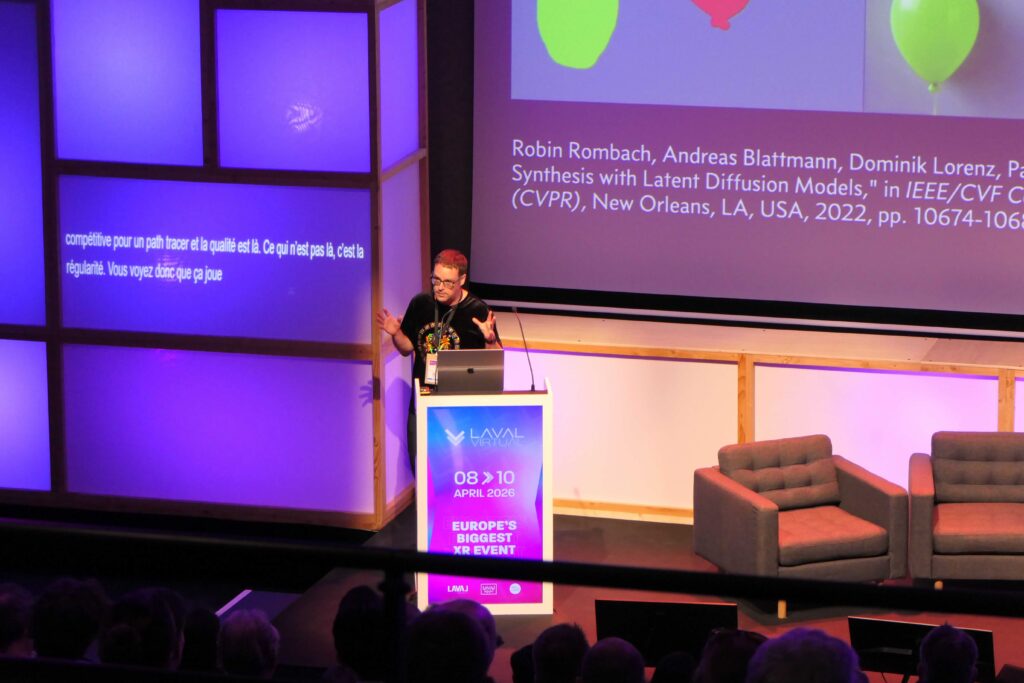
Christian Sandor, professor at Université Paris-Saclay and an augmented reality researcher since his master’s thesis in 2000, opened the morning with a candour rarely seen in this kind of exercise.
His assessment: for decades, AR systems have hit the same wall. Too rigid for the complexity of the real world, unable to adapt to changing lighting, unexpected surfaces, or unscripted behaviours. Generative AI finally brings that adaptability.
But he also named a structural tension at the heart of the subject, which he calls the “generative AI trilemma”:
“We want speed, quality, and control [regarding generative AI — ed.]. But today, it is impossible to have all three at once.”
For a pairing of generative AI with augmented reality — which demands real-time coherence with the physical world — this is a fundamental challenge, not an implementation detail.
The Paris-Saclay researcher also highlighted a striking conclusion: the brain is remarkably susceptible to illusion. In 2011, users wearing AR glasses who saw their hands on fire reported feeling heat. Some even perceived a smell of burning. Blood flow measurements taken in 2021 confirmed a real physiological response. This is not anecdotal: it is precisely what makes XR both very powerful and very consequential.
Christophe Peroz (Google): a real inflection point, not another promise
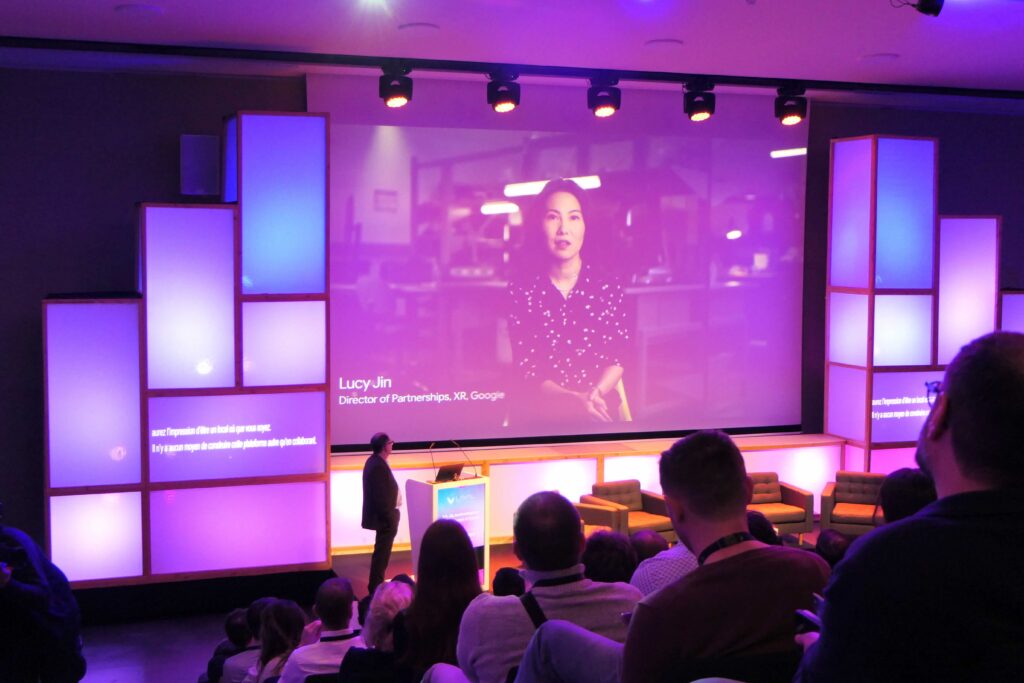
Christophe Peroz, Program Development Lead at Google based in Zurich, framed his talk around a conviction:
“The good news — and I deeply believe this — is that today we are reaching a true inflection point. We are building all the elements needed to bring XR into our daily lives.”
This conviction rests on three pillars finally coming together at the same time: multimodal AI models (enabling interaction beyond screens), a dedicated software layer and operating system (Android XR, launched in December 2024), and concrete hardware: the Samsung Galaxy XR headset, wired glasses with XREAL, and everyday AI glasses currently in development.
The “memory function” he went on to describe illustrates the qualitative leap being targeted: asking your glasses, for instance, where you put your keys earlier and getting a contextual answer. No longer an interface to consult, but an assistant that passively observes and responds on demand.
Christophe Peroz nonetheless maintained a clear-eyed view of the obstacles: optics remains the hardest problem (thin, transparent, high-performing and affordable lenses — rarely all four at once). “No single company will be able to succeed alone,” he said explicitly. Without aligned manufacturers, developers, designers and content creators, the product simply does not exist.
Thomas Bithell (IDTechEx): “Physics is physics”
Thomas Bithell, analyst at IDTechEx (an independent market intelligence firm specialising in emerging technologies), then offered the most detached perspective of the morning.
The enthusiasm around smart glasses and AI glasses is real and measurable — notably through Google Trends (with charts to back it up). This momentum is driven by announcements from Meta, XREAL, Snap, Google/Samsung and Apple, but the optical challenges are still being underestimated. Thomas Bithell summed up the core physical constraint with a direct formula:
“Physics is physics. When you increase the field of view, optical efficiency drops significantly. And that directly impacts battery life, brightness, heat, and weight.”
He went on to outline the two main technologies for displaying information on AR glasses — diffractive and reflective waveguides — each involving serious trade-offs. IDTechEx forecasts a market inflection point between 2027 and 2028, reaching around 35 million units by 2036. Deliberately more cautious projections than those of some industry players. Volume growth, the prerequisite for cost reduction, is not there yet.
Roundtable (Engo Eyewear, Arvicom, Osmose Industries): the professional market as a learning ground
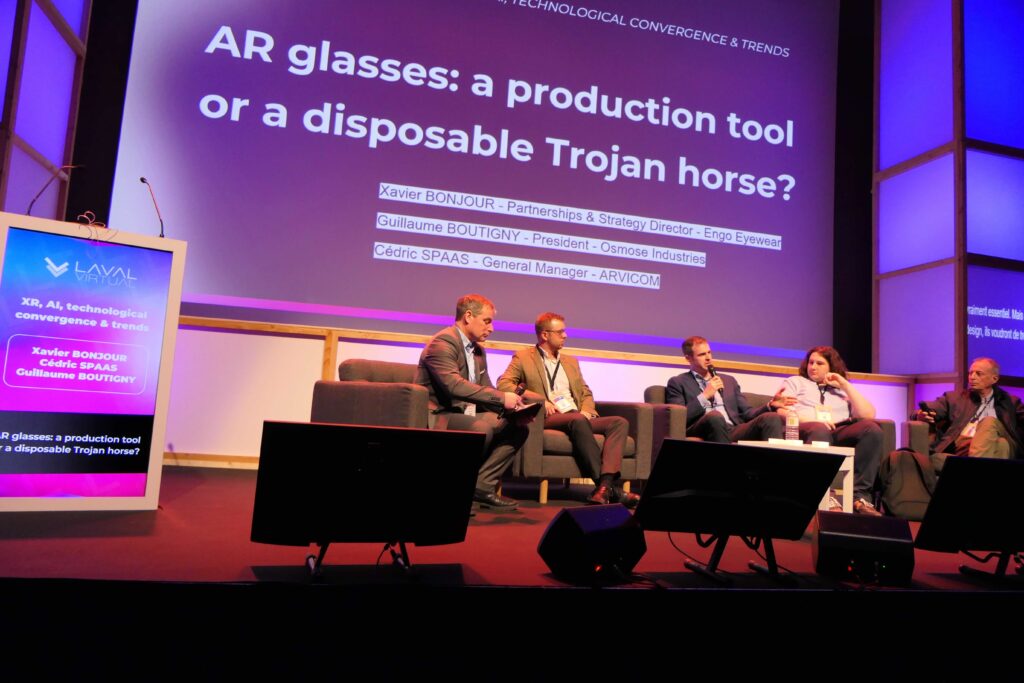
A discussion between Xavier Bonjour (Engo Eyewear), Cédric Spaas (Arvicom) and Guillaume Boutigny (Osmose Industries) brought the conversation down from strategic vision to commercial reality.
They were keen to point out that the industrial and professional AR glasses market exists, works, and is serving as a laboratory for future consumer use cases. Guided training, assisted maintenance, augmented documentation: these applications have proven their value in professional settings. But they face constraints that product announcements often gloss over: integration with existing enterprise IT infrastructure, data sovereignty issues, battery life and bandwidth limitations.
On standardisation, the three panellists were aligned. Xavier Bonjour put it plainly:
“Every player still thinks their own approach will be the one that wins.”
In their view, the diversity of formats will persist. And the key will always be the same: XR glasses must offer a clear, concrete advantage over existing tools.
David Defianas (Stellantis) and Lionel Dominjon (Clarté): driving in mixed reality
The most concrete use-case presentation of the morning was perhaps the last. David Defianas (Stellantis, XR Fellow) and Lionel Dominjon (CTO of Clarté) presented XROnBoard, a system enabling the evaluation of virtual car cockpits under real driving conditions — on a real road, using a mixed reality headset.
The starting point is precise, framed as an engineering question:
“Can we test a virtual cockpit directly on a real road?”
Testing a dashboard in a static simulation does not replicate the cognitive and behavioural conditions of actual driving. Posture, attention, mental load: everything changes when the vehicle is in motion. The solution developed by the project teams required significant work on tracking. Since headset sensors are not designed to compensate for vehicle accelerations, the team had to add vehicle-linked sensors, GNSS RTK positioning systems, and merge these separate coordinate frames.
The result is a tool already integrated into Stellantis cockpit development programmes. This is no longer applied research — it is engineering in production.
Key takeaways
Behind the diversity of presentations, the session “XR, AI, Technological Convergence & Trends” surfaces several consistent findings:
The XR promise was never invalidated — it can now better deliver with the help of AI. The use cases were always there. What was missing was the layer of adaptation and intelligence that makes systems robust in the face of real-world complexity.
Hardware remains the persistent bottleneck. AI models are advancing fast, but optics, batteries and sensors are moving more slowly. The gap creates frustration on the product side and opportunity on the components industry side.
Professional use cases generally precede consumer ones. This is not a consolation — it is a roadmap. Consumers will benefit in a few years from what industry is learning today.
The question is no longer “does it work?” but “how, under what conditions, with what guarantees?” The maturity of the sector is measured precisely by this shift in question.
Laval Virtual 2026 brought together nearly 5,000 visitors from 35 countries over three days of conferences and exhibitions at the Espace Mayenne, Laval, France. The session “XR, AI, Technological Convergence & Trends” took place on Wednesday, April 8, 2026, from 10:30 am to 12:45 pm.

