



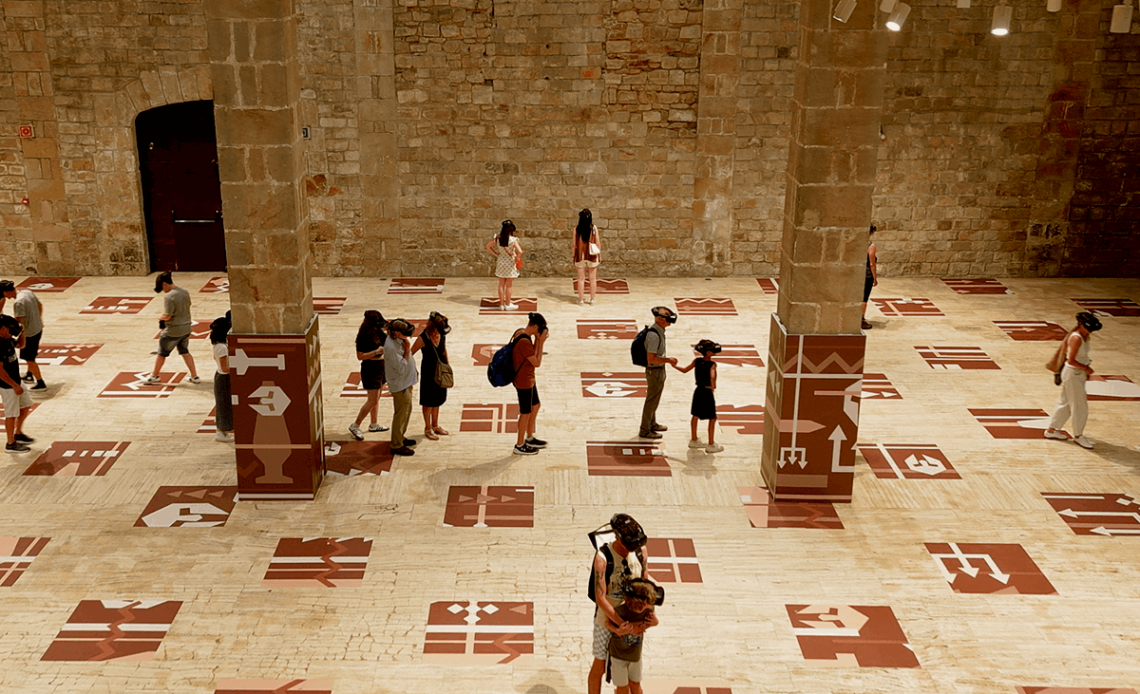
Pompeii, the last Gladiator
Crédits photos : © Univrse
Summary “Succeeding at Alternative Training Through XR” conference track, April 9, 2026
After more than a decade of experimentation, XR has established itself as a credible learning tool, but immersion alone is no guarantee of knowledge retention. Researchers, practitioners, and platform builders gathered at Laval Virtual documented the real conditions for effectiveness: alignment with cognitive mechanisms, teachers repositioned as “learning catalysts,” and the presence of internal “champions” capable of moving institutions forward. Concrete tools were also presented: digital twins for continuous industrial training, deployable classroom kits, and a global collaborative platform for cataloguing XR use cases.
Laval Virtual: 28 Years at the Crossroads of Immersive Innovation
Laval Virtual is Europe’s leading event for immersive technologies, held in Laval, Mayenne, since 1999. Its 28th edition took place from April 8 to 10, 2026, at the Espace Mayenne, bringing together researchers, industry leaders, startups, and institutions around the present and future applications of XR. The “Succeeding at Alternative Training Through XR” track on April 9 brought together six speakers from Spain, France, the Netherlands, and the United Kingdom for a state-of-the-art that was both enthusiastic and clear-eyed.
Inhabiting a Younger Body to Sharpen an Older Mind
Mel Slater, Distinguished Investigator at the University of Barcelona, delivered the keynote based on results from his “Virtual Counterclockwise” programme, built on a principle that has become central to his research: change the body, change the mindset.
The starting point is the Counterclockwise study conducted by Ellen Langer in 1979. Without virtual reality, Langer placed elderly men in an environment entirely reconstructed in the spirit of the 1950s: period clothing, magazines, television programmes. After five days, participants showed measurable improvements in physical strength, posture, vision, and cognitive performance. Slater and his colleagues built on this intuition to go further: rather than showing the past from the outside, the goal was to live it from within, by inhabiting, for the duration of an experience, one’s body from fifty years earlier.
The experimental setup involves digitally dressing participants aged 65 to 85 in an avatar modelled from a personal photograph taken forty to fifty years earlier. They are then transported in virtual reality into an immersive reconstruction of Massiel’s Eurovision 1968 performance, or a Serrat concert in a Madrid theatre from the 1970s. A control group lives the same experience, but in a contemporary setting and without any bodily change.
“Change the body, change the mind.”
Results, analysed using methodology adapted for small samples, are clear in the short term: the “young self” group shows a lower subjective perception of age, better cognitive performance, and significantly stronger grip. Most effects, however, fade after about a month.
Slater himself flagged the limits of his protocol: two ten-minute exposures cannot compete with five days of total immersion. He sketched the outline of a “cognitive fitness” application (a suite of repeatable experiences) to achieve lasting effects. The uncanny valley question, raised from the audience, also held his attention. Current avatars remain sufficiently “cartoonish” to avoid triggering discomfort, but as avatars approach photorealism, the picture may shift.
Another avenue, raised in response to an audience question, is augmented reality in daily use: wearing smart glasses that permanently display a younger version of oneself. Slater noted that passthrough augmented reality experiences produce even stronger effects than standard VR, because the brain instinctively treats what occurs in real physical space as something that has actually happened.
The Three Barriers to XR Training in Organisations
The panel moderated by Grégory Maubon brought together Valériane Loison, doctor and temporary teaching and research associate in information and communication sciences at Le Mans Université, Daniel Mellet-d’Huart, a consultant with thirty years of experience in professional training, and Nikita Kayal, Business Partner and designer at Improvive (Netherlands).
Three levels of resistance were identified and discussed: the learner, the teacher, and the institution.
On the learner side, Loison’s research on dental surgery training reveals that some students express reluctance to wear a headset (the screen in front of their eyes creates a form of discomfort) without this constituting a decisive obstacle: as soon as the teacher explicitly encourages use of the tool, students follow. Kayal of Improvive added nuance: user resistance is often incidental, linked to poor design rather than principled rejection.
“Human beings resist anything imposed on them, anything that makes no sense to them.”
On the teacher side, the change of role runs deep. The traditional trainer draws legitimacy from direct transmission of knowledge. With XR, that transmission is handled by the device itself. The trainer becomes what Mellet-d’Huart calls a “learning catalyst”: a debrief expert, ethical guardian, and guide for transfer into real-world situations. Artificial intelligence plays a key role here: where conversational agents of the 1990s required laborious scripting, generative AI now enables natural interactions that free up teacher time for what genuinely matters.
On the institutional side, Loison identified a lack of shared vision between institutional actors, teachers, and learners, each operating on different interests and timescales. Kayal introduced a central concept: the “champion.” In every organisation, certain people know how to navigate bureaucracy, identify budgets, and mobilise the right decision-makers. Without them, even the best XR solutions run into institutional inertia.
All three speakers converged on one straightforward principle: start with what is not working. There is little point in trying to replace what already works; entering through the pain point is always more convincing than arguing for marginal additional effectiveness.
What the Brain Actually Retains from an Immersive Experience
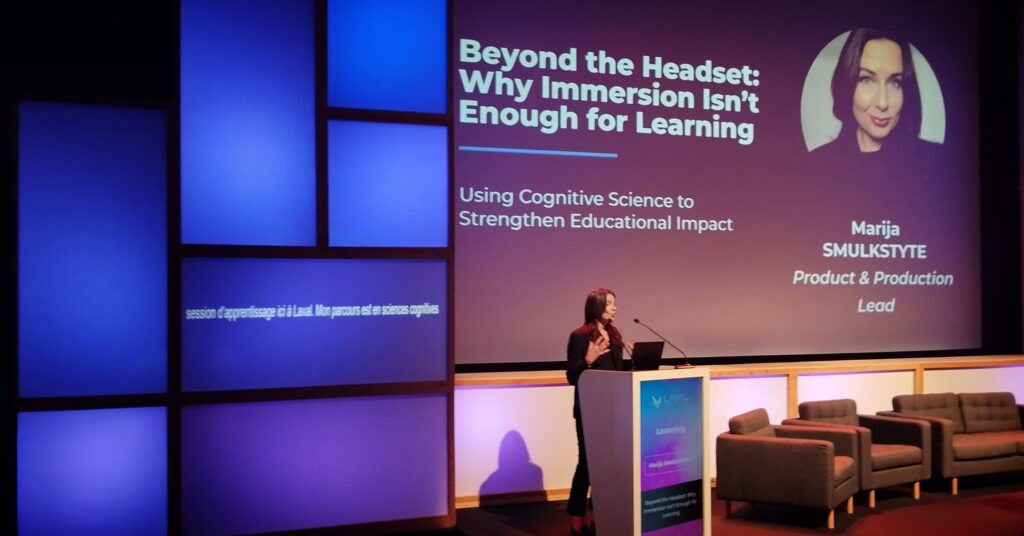
Marija Smulkstyte, Product Lead in applied cognitive sciences, drew on her field experience in LBVR (location-based virtual reality) to deliver a clear warning: immersion creates the illusion of learning: it does not guarantee it.
She opened with the famous invisible gorilla experiment (Simons and Chabris, 1999) to remind the audience that human attention is selective and limited. In VR, if attention is captured by spectacular visual effects, the pedagogical content becomes precisely that gorilla: present in the environment, but invisible.
“Immersion without cognitive alignment offers only an illusion of learning. Feedback is excellent in the moment, eyes light up, but retention erodes over time.”
The project she led for the Catalan government, “In the Eyes of History,” illustrates how to work around this risk. Five historical sites (medieval castles, monasteries, a church) were reconstructed in LBVR for school classes. Four design principles guided the work.
The first is the priority of action: every pedagogical concept is anchored in a physical interaction, to direct attention purposefully. The second is cognitive load management: a “focus mode” suppresses non-essential stimuli during key learning moments, reducing the risk of saturation. The third is spatial flow guidance: the freedom of movement characteristic of LBVR alternates with moments of guided repositioning, so that body, gaze, and listening align with learning moments. The fourth is rhythmic modularity: a teacher control panel allows sequences to be paused, resumed, skipped, or repeated, adapting content to the actual needs of the class.
Smulkstyte also emphasised the temporalities surrounding the VR experience. Before: provide context, explain the interactions, reduce the novelty effect. During: a tutorial on game mechanics before the pedagogical sequence begins. After: discussion, questioning, and review time to consolidate long-term memory.
The operational dimension was addressed directly. Schools are not designed for LBVR. The solution imagined by the team is a “suitcase” containing all necessary equipment, including portable walls integrating lighting and the tracking system. The setup operates like a “travelling circus”: an autonomous, reproducible infrastructure capable of visiting several schools per week.
XR Within Reach of Every Classroom
Franck Babouram, Sales Manager France at VR Expert (a Dutch company), presented the pedagogical kit developed by his company to deploy virtual reality at school scale.
The approach rests on three pillars: hardware (accessible consumer headsets, straightforward to use), software (a solution enabling teachers to see in real time what students see, build content libraries, and manage access), and support (a three-hour initial training and ongoing assistance).
The VR Expert representative illustrated his presentation with concrete achievements: 150,000 students reached in the Netherlands, a Kenyan programme identifying talented welders and directing them toward advanced training in Europe, and a range of applications spanning languages, chemistry, and medical gestures on virtual cadavers.
On the question of cost, his response was pragmatic: the financial argument rarely comes first. What convinces school leadership is the answer to a concrete need: taking classes to visit Anne Frank’s house without a travel budget, simulating fire emergencies without real risk, or practising foreign languages in an immersive environment.
He also addressed the question of parents, noting that examples drawn from daily life (accidents, crisis situations, first aid) are generally sufficient to overcome reservations. One psychological argument caught the audience’s attention: in VR, the student is not judged by peers. Only the teacher sees their mistakes and progress. This pedagogical confidentiality is, according to the sales manager, a powerful lever of trust.
The Digital Twin as Continuous Learning Infrastructure
Thomas Dexmier, Vice-President Sales and Marketing EMEA at HTC Vive, and Marc-Antoine Dupont, Head of XR and Interactive Content for Events at Dassault Systèmes, jointly presented their vision of the digital twin as a training device in industry.
Dupont set the conceptual frame: a Virtual Twin is not a simple 3D model. It is the convergence of engineering, manufacturing, and simulation data into a living system that enables continuous learning at every stage of the industrial lifecycle. The examples presented illustrated the breadth of applications: simulating the impact of flooding on the city of Douala, modelling the effect of a reduced speed limit on urban air quality, visualising the ergonomics of an assembly line before it goes into service.
Dexmier then highlighted the specific value XR brings in this context: making tangible and manipulable what would otherwise be invisible or inaccessible. He described the trajectory of the partnership between the two companies: from wired experiences on heavy PCs to wireless multi-user deployment on HTC Vive solutions, with centralised management of around thirty headsets worldwide for nearly 900 corporate events per year.
Both speakers concluded with a shared message, summarised in their title: “Turning Immersion Into Impact.” The complexity of industrial data (parameters, physical simulations, manufacturing flows) can only be grasped intuitively through an XR interface. And that interface only works if the partnership chain (hardware, software, content, deployment) is mastered end to end.
XRHQ: Toward a Wikipedia of XR Use Cases
Jeremy Dalton, founder of XRHQ and former head of the Immersive Technologies division at PwC, closed the session with the global world premiere launch of his platform.
The starting observation is one he has been making since the publication of his book Reality Check in 2019: business stakeholders continuously ask for data, return-on-investment figures, sector-specific examples. The classic response (a book, a study, a report) is too slow and too static for a sector evolving in real time.
“What if I could create a real-time platform, fed on one side by people like you and me, and on the other by artificial intelligence?”
XRHQ presents itself as a living, global library of XR use cases: a kind of Wikipedia of the concrete application of immersive technologies, updated continuously through two channels: an AI that monitors general, technology, and local press, and a user community that can submit, correct, or enrich project entries without prior registration. As on Wikipedia, no one owns an entry: knowledge is collective, open, and freely accessible. Each contribution is nevertheless credited by name, with a link to the author’s website or profile.
Each project entry records the sector, location, use cases, hardware used, MDM solutions, partners, number of headsets deployed, and, where available, quantified return-on-investment indicators. Everything is visualisable on a global map filtered by country and recent activity.
Dalton responded candidly to audience questions about the model’s limitations. Validation of AI-submitted data remains manual and centralised for now. The question of entry ownership (can anyone modify an entry you submitted yourself?) was acknowledged as unresolved: the tension between collective intelligence and authorial rights over one’s own projects is not unlike the founding debates of Wikipedia itself. Automated report generation and API integration are envisaged as future premium features.
The platform was accessible from launch day at alpha.xrhq.com and already hosted more than a hundred entries at the time of the presentation.
What We Take Away at Laval Virtual
1. XR’s pedagogical effectiveness is documented, but conditional. Mel Slater’s embodiment research, the results of the Catalan “In the Eyes of History” project, and Improvive’s field experience all converge: XR produces measurable effects on learning and cognitive well-being, provided the design is aligned with how human cognition actually works. Spectacular immersion without pedagogical grounding produces only an illusion of learning.
2. The teacher doesn’t disappear: they transform. The track revealed a clear consensus between researchers and practitioners: the educator’s role is shifting toward expert debriefer, ethical guardian, and learning catalyst. Conversational AI handles basic content delivery, freeing teacher time for deeper learning and real-world transfer.
3. The obstacle is more often institutional than technological. The technology is ready. What slows large-scale deployment is the absence of shared vision across hierarchical levels, insufficient dedicated human resources, and above all a shortage of “champions” capable of driving change from within. Entering through the unsolved problem (rather than the promise of marginal performance gains) remains the most effective strategy.
4. Proof of value is now a common good. The launch of XRHQ at Laval Virtual marks a milestone: for the first time, the global XR community has a collaborative, open tool to document the concrete applications of these technologies. The ability to convince decision-makers no longer rests solely on isolated studies or vendor white papers: it can draw on a collective, living, openly accessible evidence base.

