



Captain François Poucin, officer at the Institut de Recherche Criminelle de la Gendarmerie Nationale (IRCGN), presented project JANUS
Crédits photos : © Laval Virtual
Summary of the “Industrie & Défense” conference cycle, Thursday 9 April 2026
The essentials: XR is establishing itself as a strategic tool in both the industrial and military sectors. During the “Industrie & Défense” cycle at Laval Virtual, six speakers demonstrated how the sovereignty and security constraints specific to defence can be turned into competitive advantages for the entire immersive technology sector, and how concrete use cases are redrawing the boundary between civilian and military applications. The architecture decisions made under defence constraints (off-cloud deployment, data traceability, modular infrastructure) are proving directly transferable to the most demanding industrial environments. Europe’s XR sovereignty, speakers agreed, must be built on software and data rather than hardware: the realistic battleground lies in code, deployment architecture and data control.
Laval Virtual: 28 years of immersive innovation
Laval Virtual is Europe’s leading reference event for immersive technologies, held annually in Laval, in the Mayenne department of France, since 1999. Its 28th edition took place from 8 to 10 April 2026 at the Espace Mayenne, bringing together researchers, industry players, institutions and startups around concrete applications of virtual, augmented and mixed reality. The “Industrie & Défense” cycle on 9 April 2026 offered an alternating programme of panels and use cases, enabling direct dialogue between experts from both worlds.
Working for the defence industry begins with a culture shift
Maria Madarieta, CSM and R&D Manager at Virtualware, a Spanish company specialising in XR solutions for industry and defence, opened the panel with a question many hesitate to ask: is it actually possible for a small or medium-sized enterprise to enter the defence market?
The answer is a nuanced one. She described a viable access route through innovation programmes that allow startups and SMEs to co-develop solutions with defence ministries, on the condition that outcomes are shared. This model opens doors, but requires a deep transformation of cost structures.
“Prepare your product from the beginning thinking you are going to be in a very demanding infrastructure. That is the key. It works in nuclear, in defence, and in civilian industries.”
She then shared an empirical rule of thumb: the cost of an industrial MVP must be multiplied by five to ten to reach industrialised product standards, then again by two to three to meet defence-sector requirements. It is not simply a matter of money, she noted, but of effort and organisational maturity. Virtualware has lived this journey with its Viroo platform, designed from the outset for constrained environments: the same codebase can now be deployed in a Spanish health school, a railway infrastructure, or a military setting, with differentiated access rights.
The Virtualware representative also highlighted a prerequisite that is rarely documented: military culture. Long, highly hierarchical decision cycles, specific communication codes and registers: all of these must be mastered before making first contact. Fabien Dumon extended this point without hesitation: “There is a culture, a specific language to talk with them, and you need to learn that before talking with them.” Patience and time, she concluded.
XR sovereignty: choosing your battles wisely
Fabien Dumon, Immersive Technologies Leader at Airbus Defence and Space and head of the immersive technology innovation cluster, broadened the discussion to the scale of a major industrial group. On the question of hardware sovereignty, the executive was direct: in the XR field, it is an illusion. The only truly mature headset manufacturers are Meta, Microsoft (now absent from the market) and Apple. No European company has the investment capacity to compete, Airbus included. For the sector, sovereignty must focus where it remains achievable: data, software and deployment architectures.
“You cannot ask military people to start their device by entering their Facebook account or their Apple ID. That is the main problem.”
On the technical architecture front, the specialist argued for a modular approach designed from the outset to run on Google Cloud, Azure, or on a local infrastructure without any cloud dependency: the sine qua non for working with defence. The AirCube platform, developed internally at Airbus, embodies this logic: first deployed on military programmes, it now covers the full lifecycle of both civil and military aircraft, from engineering to maintenance.
He also pointed to a structural European gap that is rarely acknowledged: the absence of a sovereign 3D rendering engine. Dassault Systèmes is working on the subject, but the complete XR technology chain remains heavily dependent on American players.
Dual use: the discreet catalyst of the XR sector
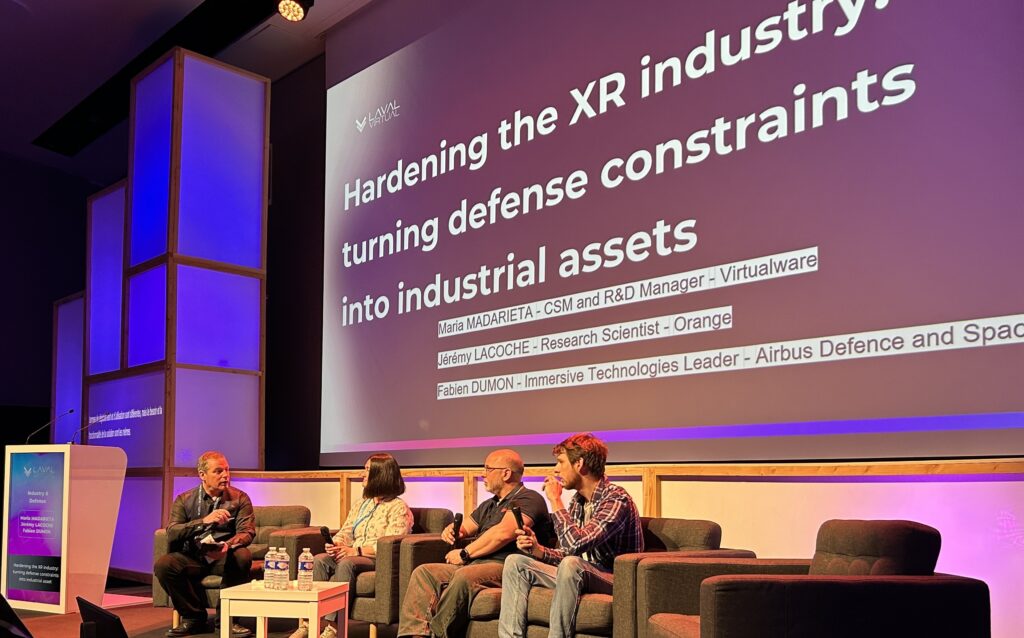
Jérémy Lacoche, researcher at Orange Innovation specialising in digital twins and XR for augmented technicians, brought the perspective of a telecom operator engaged in use cases at the intersection of civilian and military applications.
He illustrated the concept of dual use with a concrete example: Orange now uses its telecom towers to monitor potentially malicious drones near nuclear power plants. A civilian infrastructure repurposed for national security missions.
He also noted a background trend visible across several editions of Laval Virtual: solutions originally designed for entertainment or industry are progressively migrating towards defence, sometimes within just a few years. The case of Varjo is a recent illustration: long positioned as an industrial reference, the Finnish manufacturer now explicitly targets military simulation sectors in its communications. On software sovereignty, the Orange researcher mentioned the work of the CNXR in France, which is mapping the full XR value chain to identify precisely where Europe is present or absent. He considers this work indispensable for guiding industrial decisions.
The crime scene made navigable
Captain François Poucin, officer at the Institut de Recherche Criminelle de la Gendarmerie Nationale (IRCGN), presented project JANUS: a system for digitising, reconstructing and immersively visualising crime scenes, developed entirely in-house by a small team of developers. It was the Gendarmerie Nationale’s first intervention in 28 editions of Laval Virtual. Its presence was welcomed as a symbol of the sector’s maturity.
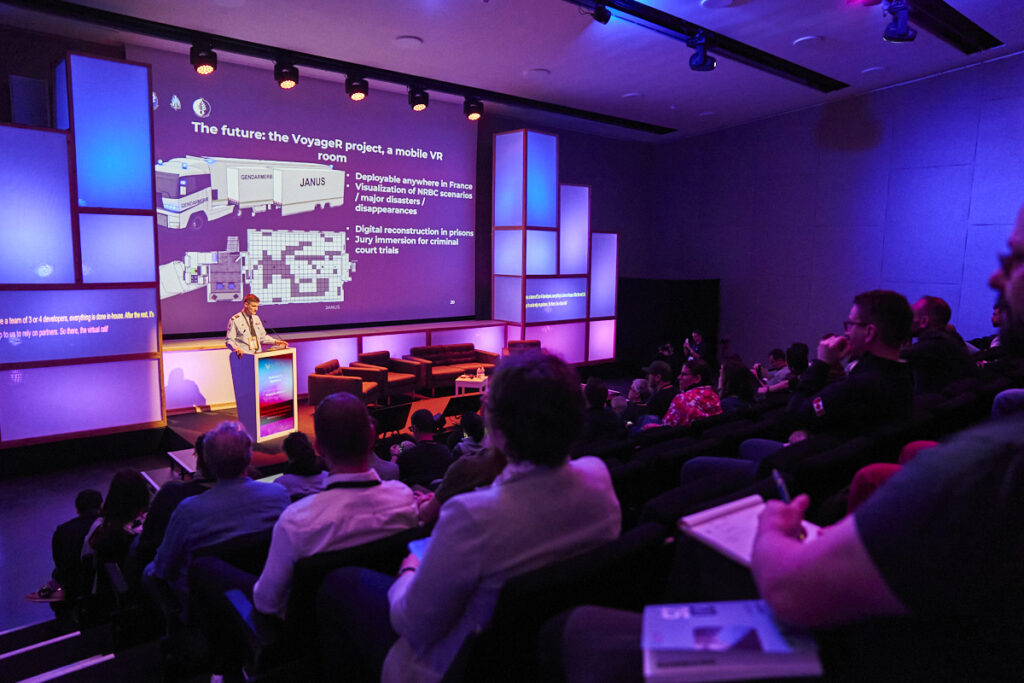
JANUS rests on four stages: laser or drone acquisition (Faro scanners, DJI drones, photogrammetry covering up to 50 km²), creation of a metrically certified digital twin (COFRAC-level quality assurance), implementation of forensic elements, and visualisation across all platforms (smartphone, tablet, Windows, Linux, Pico headset). The officer was firm on one imperative:
“Il ne sert strictement à rien de faire des choses magnifiques si on ne peut pas les utiliser ou les partager. Si on doit envoyer un jumeau numérique en Nouvelle-Calédonie, le réseau n’est pas forcément adéquat.”
The modules developed go well beyond simple visualisation. Digital judicial reconstruction allows a defendant to be placed inside the 3D environment of a crime without any physical transfer. Camera matching, applied notably to cases of failure to stop for police, makes it possible to reposition all available cameras within the 3D environment, animate the scene over time, and have jurors adopt the exact viewpoint of the driver at the moment of the facts. The objective is pure observation, free from interpretation.
Project Voyager, currently under development within the IRCGN, extends this logic further: a “virtual reality truck”, to be produced by a French company, will enable judicial reconstructions to be conducted directly inside remand prisons, without the defendant needing to be transferred. The IRCGN retains full ownership of the software solution and relies on French partners for hardware, Varonia in particular.
The digital twin within everyone’s reach
Emmanuel Mouren, CEO of WeMap, a French company specialising in spatial mapping, opened his presentation by pushing back against the prevailing narrative around digital twins. His starting point: digital twins are expensive to build, become obsolete the moment they are published, and never sufficiently justify the cost of updating. A vicious circle well known to operators of complex sites. WeMap’s answer rests on a 360-degree camera, an AI-powered image-processing pipeline, and a capture process conducted at a normal walking pace with no technical expertise required. The CEO summed up this shift in paradigm:
“Our retail customers manage their own updates four times a year, without any intervention from WeMap. That is the real paradigm shift.”
The figures presented are striking. The capture of the Louvre (70,000 m²) was carried out by a single person in one day, with one day of post-processing. Seventeen stores of a national retail brand, each exceeding 5,000 m², were covered by one person in one month. Across the SNCF network, detection of tactile paving strips on platforms was rolled out to more than 50 stations in under 15 minutes per station, after two hours of training on a reference station.
Applications span asset management, maintenance, sensor-free indoor navigation, and natural-language asset search without prior annotation (using a Vision Language Model), including, for example, the detection of mould in metro stations. WeMap operates on a principle of full sovereignty: captured data belongs to the client, processing can be internalised, and there is no dependency on third-party providers. In closing, the CEO noted recent advances from Niantic Spatial, which is using the same 360-degree cameras as WeMap to build 3D Gaussian Splats: a signal that the technological direction chosen by the company appears to be the right one.
Training humanitarian workers faster than crises accumulate
Guillaume Auvray, Head of Innovation at XR Ireland, presented the CMEX Builder platform, developed in partnership with Action Contre la Faim (ACF) as part of the European Cortex-2 project (EU Horizon).
“Raise your hand if you can name a conflict or natural disaster that made the headlines last month.” That was the slightly provocative question he posed to the room. Everyone raised their hand. The observation is simple: crises accumulate faster than the capacity to respond to them. Humanitarian organisations, civil protection services and critical infrastructure operators share the same mission. But the complexity of simulation exercises has grown so significantly that most can afford only one or two training cycles per year.
“Some exercises took 12 months to define. We want to bring that timeline down to a few days.”
The technical response rests on a common description language (the CEDL: Simulation Exercise Definition Language) that enables any crisis scenario to be structured in a format readable by both humans and machines. Built on internationally recognised standards (the Sendai framework, the UN disaster risk taxonomy, European critical entities resilience regulation), it ensures that modules created by one organisation can be reused by another.
The platform is designed to run on European cloud infrastructure (Scaleway exclusively), on local on-premises infrastructure, or from portable server racks for deployments with no connectivity. An AI assistant (Mistral, hosted in Europe) supports exercise design. Decisions made during simulation are captured in real time and fed back to trainers for longitudinal analysis of team progression. The speaker also noted that the platform targets industry (risk reduction on industrial sites) and could, in time, connect civil protection and defence around shared standards.
Defence and industry: the Finns are not waiting
The Finnish panel, facilitated by Sarita Blomqvist (Dimecc Oy / Metaverse Finland), concluded the cycle by broadening the reflection to a European scale. Dorian Frayssinet, Area Sales Manager at Varjo (the only European manufacturer of high-precision mixed reality headsets still in operation), noted a fundamental shift since the outbreak of the conflict in Ukraine:
“The fact that we are a European company matters now. When I joined Varjo four years ago, I had the naïve belief that it was an important criterion. At the time, nobody cared.”
The sales manager described how Varjo is now training F-16 pilots in Ukraine using its headsets: an alternative to simulation domes costing between 5 and 20 million euros with 18-month lead times. He also highlighted the convergence underway between military simulation and civil certification: two industrial players announced mixed reality training certifications using Varjo technology for civil aviation this year alone.

Sauli Kiviranta, CEO of Delta Cygni Labs, a specialist in connectivity solutions for distributed XR systems, identified iteration speed as a fundamental rupture: where defence traditionally operated on decade-long cycles, Ukraine iterates in weeks or months. He drew a striking parallel between the shortage of Ukrainian drone pilots and the skills shortages in the mining or port industries: two structurally identical problems to which XR and remote operations provide the same answer.
Mika Luimula, Head of Education and Research at Turku University of Applied Sciences and co-founder of Proverse, stressed the cognitive load challenges involved in supervising fleets of autonomous systems (drones, agricultural tractors, industrial equipment). He presented two pending patents: a real-time drone detection system via 360-degree video streaming, and a rapid 3D modelling tool for preparing field operations.
The panel converged on several conclusions. Europe holds sovereign competencies in telecommunications (two of the three global network equipment manufacturers are European), shipbuilding, and airspace management. The main vulnerability remains the hardware chain: from microchips to the assembly of complex electromechanical systems, dependencies are numerous and warning signals are multiplying, notably with recent supply chain attacks targeting open source projects.
What We Take Away at Laval Virtual
During the ‘Industrie & Défense’ cycle, six speakers from different sectors – but conclusions that converge.
1. Defence constraints are a quality accelerator for the entire sector. Modular architecture, off-cloud deployment, data traceability: requirements imposed by defence constitute an immediate competitive advantage in the most demanding industrial environments. Companies that integrate them from the design stage, as Virtualware has done with Viroo, no longer need to choose between markets.
2. XR sovereignty runs through software and data, not hardware. All speakers acknowledged the impossibility of hardware-layer sovereignty (headsets, GPUs, cloud infrastructure). The genuinely defensible ground lies in code, deployment architecture and data control, as demonstrated by the IRCGN’s JANUS project and the WeMap platform.
3. Compressing timescales transforms use before it transforms products. Whether digitising 70,000 m² in a single day, reconstructing a crime scene in a VR environment, or training pilots in weeks rather than waiting 18 months for a simulator, XR does not merely expand the realm of the possible: it compresses the timelines. That temporal delta is where real strategic value is created.

