



Crédits photos : © Prisma Laval Virtual
Winner of the Education & Training category at the Laval Virtual Awards 2026, the AquaWave Ensemble system, developed by the LumiSound XR Lab at National Tsing Hua University in Taiwan, took home the prize awarded on 9 April at the Espace Mayenne. Held in Laval for 28 years, Europe’s largest XR event recognises the most promising XR projects each year across a range of categories. The Education & Training category honours experiences that redefine the transmission of knowledge.
Virtual reality, in its most common form, remains a solitary experience: you put on a headset and cut yourself off from the rest of the room. AquaWave Ensemble inverts this paradigm, transforming the medium into a tool for collective creation for an entire class. One student wears the headset and enters a virtual underwater environment, their first-person view projected on a large screen so the whole group can follow what unfolds. The other students participate via tablets, shaping the scene together through virtual elements that directly trigger sound and visual events. Thanks to full-colour passthrough, the student in the headset can also see parts of the real classroom, and respond to their classmates through real-time gestures and movement.
VR as a medium for collective creation
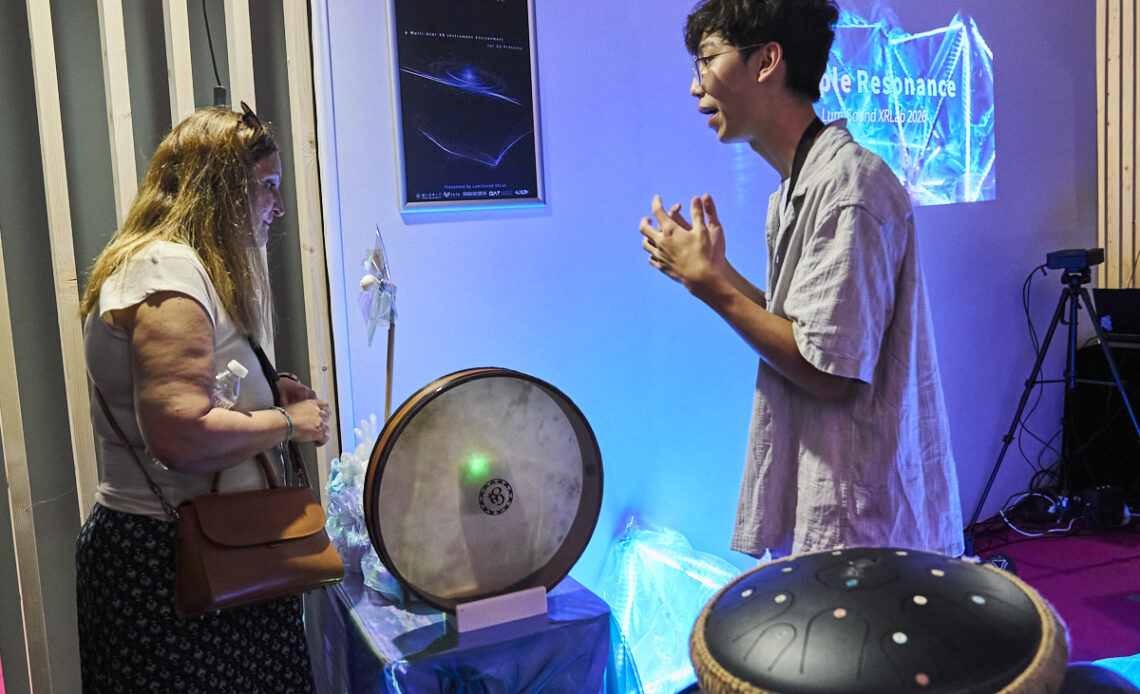
The system was presented on stage by Yi Chun Ko of the LumiSound XR Lab, who was keen to emphasise the intuitive and playful nature of the tool before handing over to the laboratory director: “We make instruments that we designed ourselves, to make it intuitive to use, and to make the whole process interesting and narrative, capable of inviting not only children but also adults to engage in the interaction.”
One of the most distinctive aspects of the project is that students do not simply play existing instruments: they first design their own 3D instruments using artificial intelligence tools, then import them into the system as playable, sound-producing elements. Each instrument is paired with a set of intuitive gestures that reflect its sonic and expressive qualities, allowing musical ideas to be learned directly through physical action. Students with no prior musical training can begin playing, exploring and composing together within minutes.
Instruments imagined by the students themselves, with AI
The project has its roots in research conducted ten years ago by a laboratory researcher working with autistic children, before being extended to a broader audience. Today, the system has been deployed in art, music and language classes, from primary school to university, with a modular architecture that allows instruments, content and scenes to be updated without changing the interaction logic. A design built for repeated classroom use, rather than one-off demonstration.
The oceanic aesthetic of the system is not a purely decorative choice. “It is magical, it is full of wonder,” the team summed up on stage, emphasising that they want to convey that feeling before any theoretical notion. With AquaWave Ensemble, teachers no longer manage devices: they orchestrate collective expression, where artificial intelligence does not generate on behalf of the students, but amplifies their imagination.

