



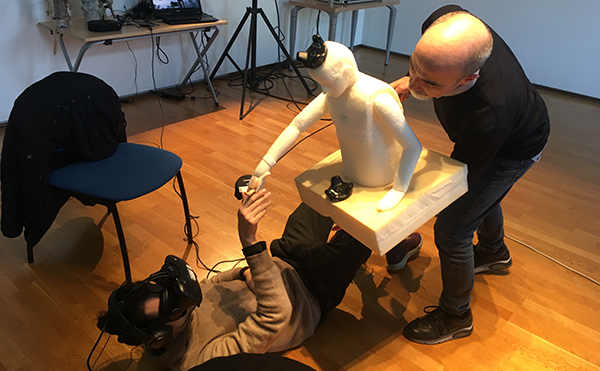
Crédits photos : ©WAVY
Winner of the #ReVolution competition at the Laval Virtual Awards 2026, the WAVY haptic device, developed by CEA List, took home the prize awarded on 9 April at the Espace Mayenne. Held in Laval for 28 years, Europe’s largest XR event recognises the most promising XR projects each year across a range of categories. The #ReVolution competition, reserved for research laboratories, universities and R&D departments, this year honours a connected glove that could fill one of immersion’s last blind spots: the sense of touch.
Seeing and hearing in virtual reality has long been mastered. Feeling, much less so. That is precisely the challenge tackled by WAVY (Wearable hAptics for Virtual realitY), a project led by a team of six researchers at CEA List in Palaiseau, within the sensory and ambient interfaces laboratory.
The project grew out of an almost chance encounter. An artist wanted to explore the creation of an intimate connection with an avatar and was looking for a device capable of conveying that sensation. Nothing on the market would do. The CEA List team set about designing their own glove, capable of delivering multiple types of haptic feedback in a realistic way, drawing on visual and auditory senses to amplify the experience.
A forty-year-old challenge
The technical challenge is significant. Research into haptics in VR dates back to the 1980s, but for a long time focused on isolated solutions: either rigid exoskeletons, precise but heavy and costly, or simple vibrotactile gloves, lightweight but limited to basic vibrations. Few devices manage to combine kinesthetic feedback (the sensation of force and resistance) and cutaneous feedback (texture, contact) in a single portable, affordable and comfortable object.
WAVY offers an original answer: an active braking mechanism using lubrication, driven by piezoelectric actuators. The principle involves reducing friction between two surfaces through ultrasonic vibrations, generating resistive, viscous or textured effects depending on the intensity applied. Implemented across three fingers, this system delivers force feedback during finger flexion, with performance exceeding previously published results in the scientific literature: up to 95% reduction in friction force, with a controllable and repeatable force range between 0.24 and 2.65 newtons on the first wearable prototype.
This braking mechanism is combined with an off-the-shelf motor to simulate palm pressure, such as a heartbeat or an avatar’s handshake, and with vibrotactile actuators placed on the palm and two fingers to produce a wide variety of sensations. The team also exploited sensory illusions, including apparent motion, to amplify vibrotactile effects using a limited number of actuators, while creating the illusion of continuous movement across the entire hand.
The experience presented to the Laval Virtual audience and jury immerses the user in an Egyptian setting, where the god Sobek guides a soul through its passage to the spiritual world. Beating hearts, contact with insects, varied tactile interactions: the device was designed, tested and refined throughout an iterative cycle involving artists, consortium partners and external testers, until reaching a modular, compact design that adapts to different hand sizes and is visually polished.
From the laboratory to creative practice
But WAVY does not stop at the laboratory prototype. The team has developed communication modules and native Unity integration, allowing creators without advanced programming skills to easily add interactive haptic content to their own scenes. A decision that immediately broadens the scope of the device, from maxillofacial surgical simulation to artistic creation and education.
The #ReVolution prize rewards the most promising research project each year, with an invitation to exhibit at SIGGRAPH, the world’s leading conference on computer graphics and interactive techniques, taking place this year in Los Angeles in July. A prestigious showcase for a technology born from a simple question: what if virtual reality could finally be felt?

