



Crédits photos : © Prisma / Laval Virtual
Summary of the conference cycle “XR for Health and Well-Being” of April 9, 2026
The essentials: XR in healthcare has crossed a decisive threshold. It is no longer an experimental tool but a recognised clinical instrument, whose integration into care pathways now faces regulatory, economic, and organisational challenges more than questions of efficacy. From spinal rehabilitation protocols to 3D imaging-assisted surgery and anxiety preparation for patients before medical appointments, the speakers mapped out a demanding and clear-eyed picture of a sector in full structuration. The consensus is unambiguous: the next step is no longer to convince clinicians of XR’s usefulness, but to build the economic models, regulatory frameworks, and training programmes that will enable large-scale deployment.
Laval Virtual: 28 editions at the crossroads of innovation and real-world applications
Laval Virtual is Europe’s leading event for immersive technologies and their applications. For its 28th edition, held from 8 to 10 April 2026 at the Espace Mayenne in Laval, the event brought together researchers, industry professionals, healthcare practitioners, and creators around the concrete uses of virtual, augmented, and mixed reality. The cycle “XR for Health and Well-Being” occupied an entire morning, confirming the central role the medical sector now plays in the global XR ecosystem.
Thirty years of scientific literature and a new way of understanding human behaviour
Pietro Cipresso, Associate Professor in Psychometrics at the University of Turin, opened the cycle with a keynote spanning three decades of virtual reality’s evolution in healthcare. His starting method is as singular as it is rigorous: an exhaustive analysis of all VR publications indexed in the Web of Science, updated continuously since 2018. The resulting article, “The Past, Present and Future of Virtual Reality,” has exceeded 1,700 citations, a sign that the question resonates well beyond specialist circles.
What this mapping reveals is a historic shift. The past twenty years have seen scientific output on VR migrate massively toward clinical applications: neurology, surgery, rehabilitation, psychology, neurosciences. The Turin researcher identifies three successive eras: a pioneer era centred on engineering, a development era focused on ergonomics and behavioural assessment, and finally a clinical era, which began around 2010 and continues today, in which VR has established itself as a therapeutic instrument in its own right.
To illustrate this maturity, Pietro Cipresso points to a VR Cave installed in 2015 in a Milan hospital, one of the first devices of its kind integrated into a care facility. Today, via this system, VR exposure therapy and VR post-stroke rehabilitation are, according to him, recognised clinical standards. He then highlights a less visible but equally structural transformation: hardware has become a commodity (headsets now weigh a few hundred grams, compared to several dozen kilos at the field’s beginnings), and artificial intelligence is making applications accessible to all. As a result, human expertise has become the scarce resource. Specialised doctoral programmes in VR, the training of young researchers, profiles capable of bridging technology and clinical practice: these are what the sector must now prioritise building.
The most forward-looking part of his presentation concerns what he calls the measurement of behavioural dynamics. The Turin professor delivers a pointed diagnosis of current approaches: by measuring only states (an emotion or behaviour at a given moment), researchers risk confusing two very different mechanisms that produce the same score. True understanding of a system, whether in psychology or neurology, requires controlled perturbation and observation of its recovery trajectory. This is precisely what virtual reality enables: creating programmable environments, introducing a stressor, and measuring the recovery dynamic, through gaze tracking, kinematics, or physiology, for instance.
This paradigm, which he connects to neuroscientific techniques such as transcranial magnetic stimulation (TMS), opens, in his view, a path toward a “computational ethology” of human behaviour, still largely unexplored. He calls on the community not to limit itself to data fusion, but to build genuine dynamic models, agents, systems, and simulations, in order to understand not what a patient feels, but how their system reconfigures itself in response to a perturbation.
From the care room to the field: the real conditions of XR adoption
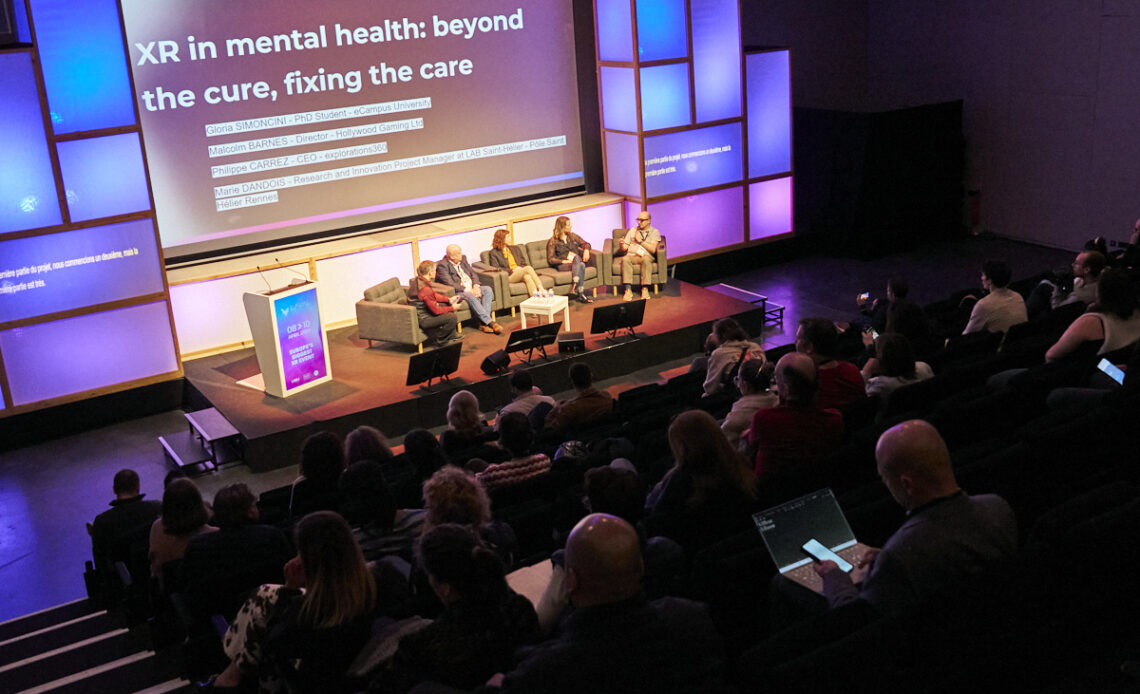
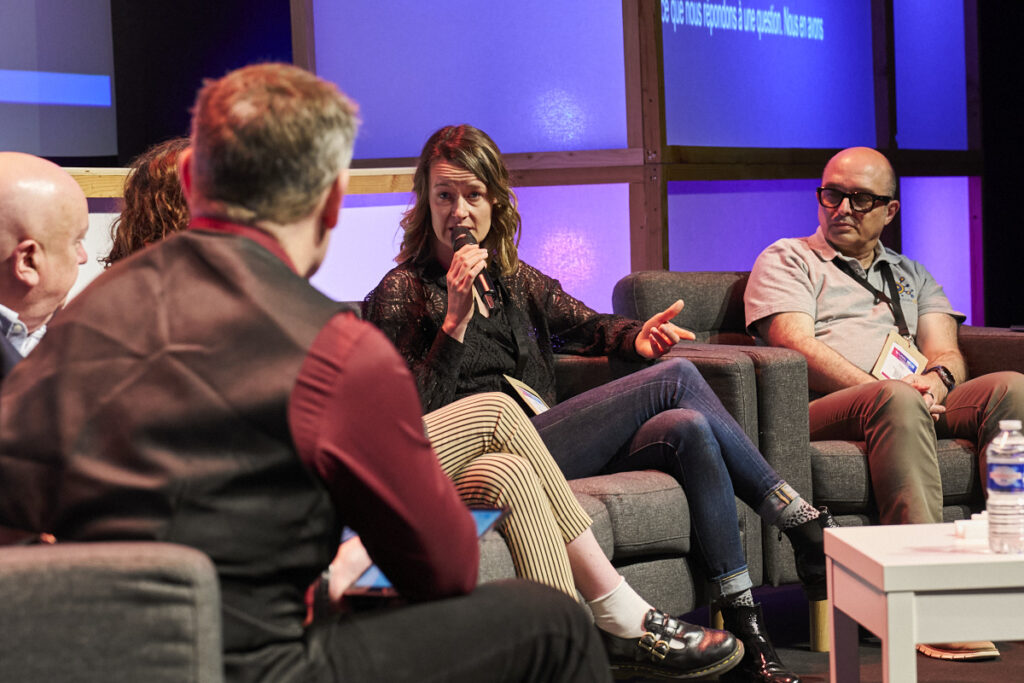
The following panel brought together four practitioners with complementary profiles: Gloria Simoncini, PhD student in psychometrics and clinical neuropsychologist at the University of Turin; Marie Dandois, occupational therapist and Research and Innovation Project Manager at the Fondation Saint-Hélier in Rennes; Philippe Carrez, co-founder of Explorations 360, a company specialising in the creation and delivery of VR experiences; and Malcolm Barnes, Director of Hollywood Gaming, a British studio now deeply involved in XR applications in hospital settings. The opening question was deliberately simple, and deliberately provocative: are healthcare professionals convinced of XR’s efficacy? Gloria Simoncini’s nuanced reply set the tone for the exchange:
“I think the efficacy of VR is no longer questioned by many healthcare professionals, because they know they can use it for anxiety, rehabilitation, and pain. But some remain sceptical. They need to be supported, to train, and to practise using VR.”
This need to accompany professionals emerged as a through-line for the panel. Malcolm Barnes stressed the role of “internal ambassadors”: when a convinced clinician adopts the technology, they bring their peers along far more effectively than any commercial demonstration could. Gloria Simoncini added an essential caveat: the goal is not to convince people that a given solution is the right one, but to listen to what clinicians and patients actually need, then co-construct accordingly.
Philippe Carrez provided a concrete perspective on the solution developed in partnership with the Fondation Saint-Hélier. The project’s purpose is not relaxation or escapism, but preparation for care: helping anxious patients, including people with autism, to anticipate a medical appointment before it happens, so that fear does not lead to cancellation. What the Explorations 360 co-founder calls “care avoidance” represents a real cost for institutions, in lost clinical time and deferred treatment.
“In many people’s minds, VR is used to relax patients in hospital. We build tools to face reality. We show reality.”
Ease of use is central to their approach: the device requires only pressing a single button. No technical manipulation, no risk of failure in the patient’s presence. Marie Dandois presented early feedback from this collaboration: very high acceptability, both among patients and professionals, and a promising direction for a second project phase.
Malcolm Barnes completed the picture by describing the paediatric context in which Hollywood Gaming operates in the UK. The question of appropriate hardware is central there: for very young children, or for patients with cannulas, a VR headset is not always suitable. The studio works across a range from tablets to headsets, depending on patient profiles. He also raised a rarely discussed angle: using XR to screen for anxiety and trauma in children, replacing paper forms filled in under the parents’ gaze, a context that pushes some children to minimise their difficulties. The panel concluded with a proposal that drew the room’s attention: rather than asking XR companies to “pitch” their solutions, hospitals and clinical teams should be invited to “pitch” their problems. Let those who carry the need open the dialogue, not the other way around.
Silver Explorer: a serious game co-designed with and for older adults
Jean-Jacques Temprado, Full Professor at the Institute of Movement Sciences at Aix-Marseille University, presented the Silver Explorer project, an exergame (a portmanteau of exercise and game) developed specifically to preserve the cognitive and brain health of healthy older adults. The project’s starting point is a documented paradox: video games incidentally improve cognitive functions in older adults, and the number of elderly players is growing, motivated not by entertainment but by the desire to maintain their mental capacities. Yet no game has been designed specifically for them, and existing commercial solutions remain weakly effective because they were conceived for a general audience, without scientific grounding. The Marseille researcher defends a central conviction:
“Neither researchers, clinicians, engineers, nor industry can design an effective exergame in isolation.”
This is why Silver Explorer is built from the outset on a consortium bringing together researchers, engineers, end users, and video game professionals. The methodology adopted, the MEDIA framework (contextual research, co-design, iterative testing), mobilised three years of preliminary research, carried by doctoral and master’s students. This phase made it possible to model the target user profile (people with no prior gaming literacy), identify relevant training concepts, and define the narrative and visual universe likely to match their expectations.
The game currently in development combines three simultaneous levels of stimulation: cardiovascular effort (cycling through virtual space to stimulate the release of BDNF, a protein promoting brain plasticity), complex upper-limb movements, and cognitive stimulation inspired by motor control paradigms (inhibition, rapid reaction, decision-making). All of this is framed by a narrative: the player embodies a “Silver Explorer” setting out to discover a fountain of youth, accompanied by an AI-driven avatar.
The Marseille professor was keen to dispel a commonly expressed concern: older adults do not reject VR on principle. What matters is the meaning of what is proposed to them. Several participants in the experiments, initially reluctant, changed their minds within the first minutes of immersion. What older people refuse, however, is a digital tool that attempts to replace their collective physical activities. What they expect is a complementary solution for a specific, unmet need: preserving their cognition autonomously, at home or in places they already frequent.
The team is actively seeking financial and scientific partners, and is exploring extending the platform to active leisure contexts (location-based entertainment).
Virtual reality integrated into a spinal rehabilitation programme
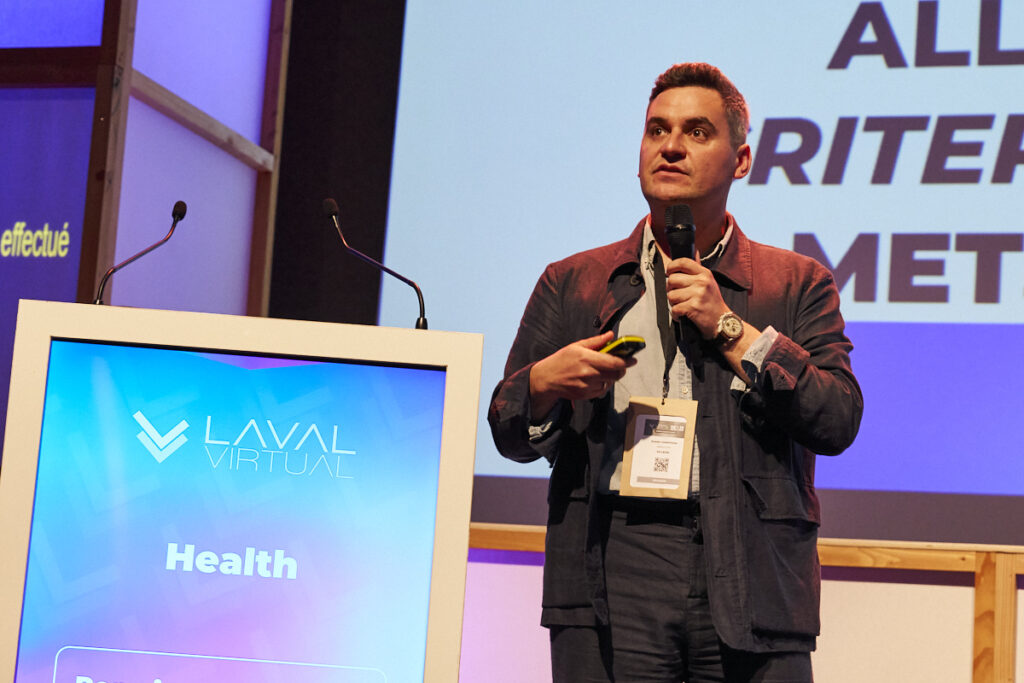
Romain Champagne, specialist in physical medicine and rehabilitation at the Centre Hospitalier de Laval, presented the results of a study conducted a few hundred metres from the conference room, in his own unit at Laval Hospital. The study, funded by the University Hospital of Angers, examined the integration of virtual reality into a functional restoration programme for chronic spinal pain.
The clinical context is well-established: low back pain is the leading cause of disability worldwide. The recommended treatment is movement, but for patients caught in the vicious cycle of kinesiophobia (fear of movement, catastrophising, avoidance, worsening disability), moving is precisely what they dread most. VR offers a workaround: in the virtual environment, patients move more readily:
“We observed that patients move more easily in virtual reality than without it. We do not know exactly how this works, but perhaps through gamification, immersion, or the possibility of imagining movement.”
The Laval physician integrated the Ability system (a controller-free VR rehabilitation device developed by a company in eastern France) at a rate of three sessions per week over four to five weeks, alongside the existing group programme. Twenty patients and several caregivers from five rehabilitation centres participated in the study.
Results are encouraging across all indicators. Caregiver acceptability before the experiment was already high (5.5 out of 7) and remained so. Among patients, acceptance increased between the start and end of the programme, with a usability score of 80 out of 100 and adherence above 80%. Most notably, intention to reuse the device increased over the course of the programme rather than declining, a rare finding in technology acceptance studies. Preliminary clinical indicators point in the same direction: reductions in pain, kinesiophobia, anxiety, and depression, alongside improved capacity to imagine movement.
One difficulty emerged on the caregiver side: organising an individual VR programme within a group rehabilitation setting proved logistically demanding. The next step under consideration is a home-based programme, with patients loaned the headset for autonomous use between centre sessions. To confirm these promising results, the team is preparing a randomised controlled trial comparing a VR-integrated rehabilitation programme with a standard programme without VR. Jean-Jacques Temprado, present in the room, noted having observed the same gap in his own project: with a mobile telepresence robot for remote physical activity, healthcare professionals were more reluctant than patients, while the patients judged the technology highly useful and wanted more of it.
The hard truths of XR as a medical device
Elodie Litzler, co-founder and Chief Operating Officer of Avatar Medical (a Franco-American spin-off from the Institut Pasteur and Institut Curie, specialising in 3D medical imaging in XR), chose to deliver a resolutely pragmatic presentation, at times running counter to the enthusiastic narratives that dominate sector conferences.
Her first move was to map the real uses of XR in healthcare into three distinct categories, with very different regulatory implications: XR as treatment (digital therapeutics), XR as a decision-support tool for clinicians, and XR as procedural assistance (surgery, interventional medicine). This distinction is not merely academic: it determines the medical device class involved, and therefore the level of regulatory requirements the manufacturer must meet.
“The medical market is so small that consumer headset manufacturers simply have no interest in it.”
This is one of the first hard truths she laid out: obtaining market authorisation (FDA in the United States, MDR in Europe) requires validating software compliance not in isolation, but against a precise list of compatible hardware. Yet consumer headset manufacturers have no reason to engage with a market that is infinitely smaller than their own. Avatar Medical thus had to conduct optical tests on Meta Quest and HTC Vive headsets to demonstrate to the FDA that their image rendering met the requirements for surgical decision-making. And when Microsoft discontinued the HoloLens, Stryker, the orthopaedics giant that had developed XR solutions on that hardware, simply decided to stop: the cost of migrating to a new headset and repeating clinical trials was prohibitive.
The second obstacle is economic. Regulatory approval does not guarantee reimbursement. And without reimbursement, large-scale deployment is blocked. The Avatar Medical co-founder presented a global overview of reimbursed XR therapies: the cases can be counted on one hand. Germany is an exception, France has launched a pilot scheme, and the United States remains fragmented between public and private payers.
There remains the path of direct economic value for the hospital, bypassing insurance reimbursement. This is the model Avatar Medical has chosen. The company developed a tool that replaces black-and-white radiological images with personalised 3D representations drawn from patient data (MRI, CT scans), displayed in stereoscopy during consultations, without a headset, on 3D screens. The goal is not only educational: patients who better understand their own anatomy are more likely to consent to the proposed surgery, which increases the institution’s revenue. It is this argument, centred on additional income rather than productivity gains (which hover around 10 to 20%), that convinces hospitals to invest.
On long-term prospects, the Avatar Medical co-founder is unambiguous: medtech start-ups developing XR products are destined to be absorbed by large groups (Medtronic, J&J, Stryker), the only players capable of shouldering global regulatory burdens. And while she considers the sector still very embryonic (walking into a random hospital and finding XR there remains the exception), she offers a reference that puts impatience into perspective: the Da Vinci surgical robot received its first FDA clearance in 2000. Twenty-six years later, robotics is a standard in operating rooms worldwide.
Ten years of XR rehabilitation: lessons from a demanding journey
Gert-Jan Brok, founder and CEO of inMotion VR, a Dutch company developing XR solutions for rehabilitation, closed the cycle with a talk combining retrospect and forward perspective. It all began in 2014, with an Oculus DK1 headset and a physiotherapist wife. Her reaction during her first immersion triggered everything: captivated by the experience, she immediately identified what was missing. “I’d love to be able to move in a natural way.” Since then, the company has developed Corpus VR, a modular rehabilitation platform that the Dutch CEO readily describes as a “toolbox,” in keeping with what therapists had been requesting from the very first consultations.
“They forced us to sell hardware and to include everything in the offer. It was a little more complex, but just as stimulating.”
Gert-Jan Brok’s account is one of constant adaptation to market realities, sometimes painful. Wanting to sell only SaaS while avoiding hardware? Impossible: clients did not know which headset to buy and demanded full support. Betting on a promising technology, only to see the partner company go bankrupt just as the product was ready. Spreading too thin across too many markets at once, to the point of losing focus on the core business. inMotion VR experienced both of these pitfalls head-on.
Among the lessons he has formalised, three stand out. The first: listen to clients carefully, but not blindly. An enthusiastic client requesting a specific feature may well fail to adopt it once developed. Enthusiasm is not a reliable predictor of use. The second: know your strengths and own them. inMotion VR creates therapeutic content, not certified medical devices. Staying within that perimeter, building partnerships with those who master what you do not, and resisting the urge to do everything yourself. The third: hold your vision in the face of doubt, including financial doubt. It is this strategic continuity, more than tactical pivots, that has allowed the company to navigate ten years in a still-forming market.
On the outlook, the inMotion VR CEO identified several drivers: the gradual disappearance of external sensors in favour of onboard camera tracking, battery evolution that will radically change headset autonomy, and control over the data generated by immersive environments. He also mentioned the often underestimated value of the enclosed environment: in certain therapeutic contexts, the absence of distraction is precisely what makes VR more effective than open screens.
What we take away at Laval Virtual
1. XR in healthcare has entered a clinical era. The thirty years of scientific publications analysed by Pietro Cipresso, the results of studies such as that conducted at the Centre Hospitalier de Laval, and the emergence of first reimbursements in several countries confirm that efficacy is no longer the central debate. What is at stake now is the speed and conditions of integration into practice.
2. The economic model remains the primary bottleneck. Elodie Litzler articulated this with a clarity rarely heard at this type of conference: without reimbursement or directly measurable value for the purchasing institution, large-scale deployment is structurally blocked. Productivity gains alone are not enough. The path forward lies either in waiting for reimbursement frameworks, or in identifying additional revenue arguments, as Avatar Medical has done.
Co-construction with end users is not a methodological option; it is a survival condition. Whether in the Silver Explorer exergame, the care preparation device at the Fondation Saint-Hélier, or inMotion VR’s decade of experience, the same conclusion holds: solutions designed without deep involvement from clinicians and patients either fail or go unused. The panel offered a striking formulation of this principle: reverse the hackathon, make problems the pitch rather than solutions.

