



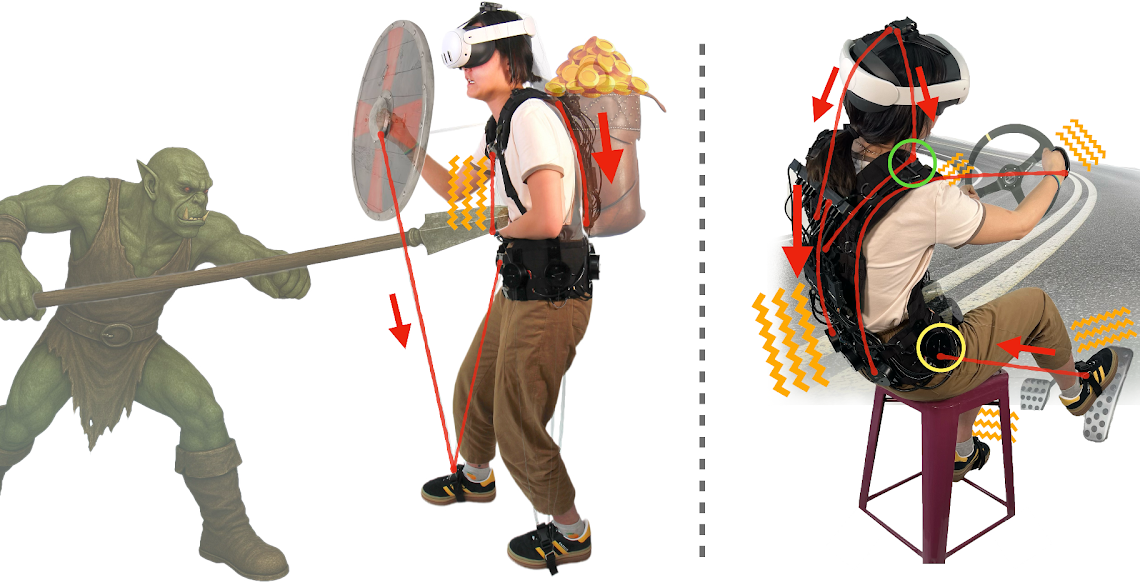
Crédits photos : © Kinethreads
Winner of the XR Devices & Interactions category at the Laval Virtual Awards 2026, the KineThreads haptic device, developed at the Future Interfaces Group at Carnegie Mellon University, took home the prize awarded on 9 April at the Espace Mayenne. Held in Laval for 28 years, Europe’s largest XR event recognises the most promising XR projects each year across a range of categories. The XR Devices & Interactions category honours the innovators designing the hardware at the boundary between the real world and virtual worlds.
You can teleport to the summit of Everest in VR, and it will look beautiful, and it will sound beautiful. But if you cannot feel the snow and the wind, it will never quite feel real. That is the starting point behind KineThreads, presented on stage by its creator, a professor of entertainment technology at Carnegie Mellon. “Touch is a very important sense that we need to address, and it remains underexplored,” she summed up.
The project focuses specifically on force feedback: the ability to simulate the weight, resistance or pressure applied to the body. Devices already exist for the hands, such as haptic gloves. The idea behind KineThreads was to scale that principle up to the entire body.
From industrial robotics to people-facing devices
In practice, KineThreads takes the form of a vest equipped with motors at the waist and back, connected via a pulley system to all extremities: hands, feet and head. The user can feel forces applied across the whole body, in an approach its creator describes as “unencumbered” for kinesthetic feedback.
The device remains lightweight (under 5 kg), quick to put on (under 30 seconds) and significantly cheaper than traditional rigid exoskeletons, which run into thousands of dollars. KineThreads comes in at around $400.
The project’s creator comes from a robotics background, with hands-on experience building industrial systems. One memory marked a turning point in her career: “I built my first haptic device, and when I saw people try it on, they started laughing and playing around. That really inspired me to keep working on people-facing devices.” A philosophy she sums up in a few words: robotics must remain oriented towards people. Behind the scientific rigour, the project’s development also has its share of anecdotes. To find the right cable for the pulley system, strong enough to apply force without hurting the user, the team bought around twenty different reels of wire and cable and tested them one by one by pulling on them. The winner: a braided fishing nylon rated to 80 pounds.
A resolutely open source approach
The project, which is also one of its creator’s doctoral research works, is fully available on GitHub. A deliberate choice: four out of five projects developed by the researcher are open source. “I am a researcher. I know that alone, I will never find the best possible solution. I really try to open source all my work. I want people to build on it and make it better.”

