



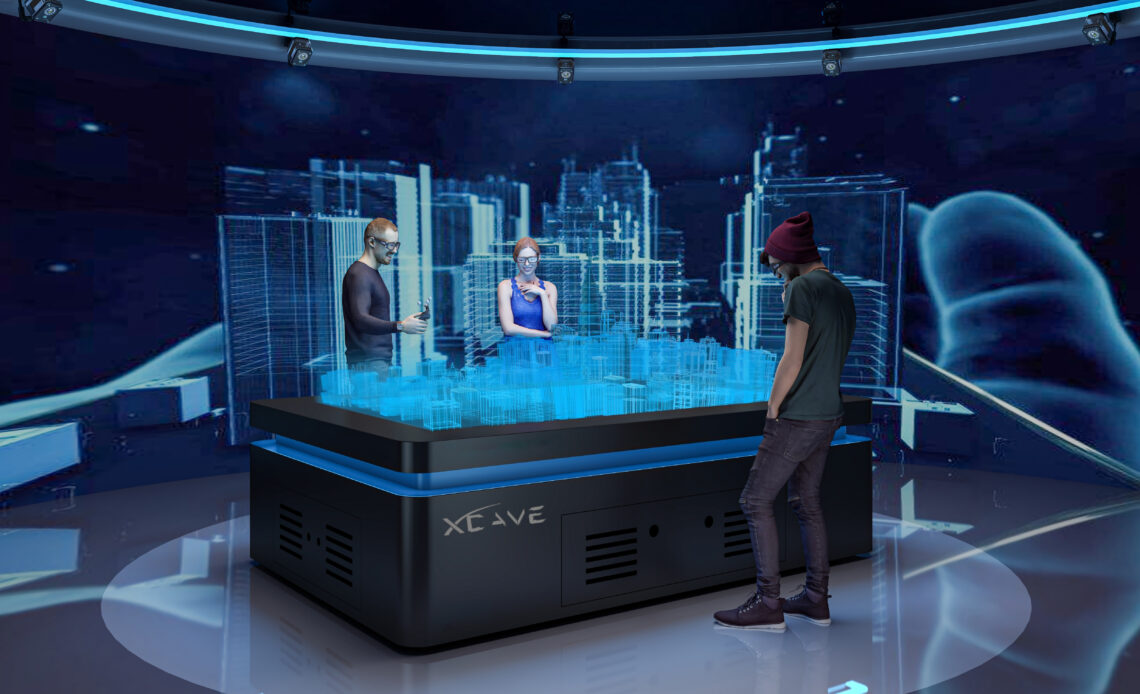
xCave Technology has developed an innovative CAVE solution that facilitates group VR sessions.
Crédits photos : xCave
Virtual reality, augmented reality, and mixed reality headsets have become widely adopted. But for professionals, they aren’t always the best solution. CAVEs offer an attractive alternative, particularly for collaborative sessions. We sat down with Steffen Hergert, Director of xCave Technology, who shared the innovation his team has developed to bring CAVE technology into the modern era.
What sets xCave Technology apart from other companies specializing in CAVEs?
xCave Technology is a pioneering force in the professional visualization and simulation sector, specializing in the design and realization of next-generation VR systems based on cutting-edge LED technology, founded in 2019. Moving away from traditional, projection-based “Caves” that often require specialized, dark environments, our company offers a versatile hybrid approach to immersive work. Our flagship solution is a high-performance collaboration system specifically tailored for modern conference rooms.
What sets our technology apart is its unique “Dual-Use” capability: the system functions as a crystal-clear, high-resolution presentation screen for standard business meetings, yet can be transitioned into a fully immersive VR mode with a single click. This versatility eliminates the need for dedicated, separate VR labs and brings immersion directly into the everyday workspace. Furthermore, our solutions are built on an open architecture, ensuring full compatibility with a wide range of CAD formats and professional visualization software.
Since our founding, we have focused on empowering engineering and design teams to bridge the gap between 2D planning and 3D reality without technical friction, offering seamless integration for external tracking solutions and specialized visualization partners to create a truly future-proof VR platform.
What will you be showcasing at your booth at the Laval Virtual exhibition?
Absolutely! Visitors to our booth at Laval Virtual will have the exclusive opportunity to experience our pioneering multi-user LED demonstrator in action. We are showcasing a high-resolution LED display—measuring approximately 2.40 meters in width and 1.40 meters in height—that solves one of the biggest challenges in collaborative virtual reality: the “single-user perspective” limitation.
While traditional VR systems usually only provide a correct 3D perspective for one tracked person, our demonstration allows three different people to view the same 3D model simultaneously, with each person receiving their own independent, perspective-corrected view. This means that all three participants can move naturally in front of the screen and see the digital prototype or architectural model from their specific physical position without any distortion.
This live demonstration highlights how xCave Technology transforms a standard meeting situation into a high-end, immersive review session. It proves that VR is no longer a solitary experience but a powerful tool for team-based decision-making. We invite all attendees to visit us at booth M58-C at the German Pavilion. Step up to the screen and see for yourself how our seamless CAD integration and advanced tracking solutions allow for a collective, high-fidelity exploration of complex data in real-time. It’s a hands-on look at the future of the “Dual-Use” conference room.
Can you tell us more about the innovation behind your CAVE solution?
Our current innovation focus lies in the advancement of high-frequency LED multiplexing for multi-user immersive environments. A major technical milestone achieved this past year was the deployment of a system supporting four simultaneous, perspective-corrected views on a single LED surface. This is technically realized through ultra-high refresh rate LED panels and synchronized active shutter technology, ensuring that each of the four participants receives a unique, low-latency 3D stream tailored to their precise spatial coordinates. This eliminates the “distortion” effect for secondary viewers and allows for true collaborative analysis of complex digital twins.
To further enhance the sense of presence and spatial orientation, we have successfully integrated active LED floors into our VR configurations. By adding a digital ground plane, we significantly increase the user’s immersion and spatial awareness. This setup provides crucial vertical parallax and ground-level visual references, which drastically reduces the “floating” sensation often found in traditional screen-based VR and creates a more cohesive immersive volume.
Furthermore, we are actively developing an Open Software Ecosystem. Rather than locking users into proprietary software, we collaborate with various VR software partners to ensure seamless data pipelines between diverse CAD/PLM environments and our LED hardware. This allows for real-time ray-tracing and physics-based simulations to be rendered across our multi-view setups without technical bottlenecks. We invite industry professionals to explore these integrated workflows at our dedicated testing facility in Stuttgart, Germany, where we continuously benchmark new software-hardware combinations to push the boundaries of collaborative digital prototyping.
In what ways does your technology have the potential to transform certain industries?
xCave Technology is fundamentally transforming the industrial design, automotive engineering, and high-end architecture (AEC) sectors by redefining how teams interact with complex 3D data. Traditionally, these industries had to choose between two extremes: individual-focused VR headsets, which isolate the user and hinder natural communication, or massive, projection-based “CAVE” systems that are technically demanding and require dedicated, dark spaces. Our LED-based VR solution creates a “third way”—a collaborative, high-fidelity environment that integrates directly into the existing office infrastructure.
One of the most concrete transformations is the acceleration of the digital prototyping process. For example, in automotive engineering, a team of four specialists can stand in front of our LED wall and examine a full-scale digital twin of a vehicle. Because each person has their own independent, perspective-corrected view, they can point to specific components, discuss ergonomics, and evaluate aesthetics simultaneously as if a physical clay model were in the room. This eliminates the “viewing lag” and distortion that usually plague group VR sessions, leading to significantly faster consensus-building and a reduction in costly physical prototypes.
Furthermore, our system’s “Dual-Use” capability transforms the conference room from a static meeting space into a dynamic decision-making hub. In architecture and urban planning, a project lead can start a meeting with a 2D budget presentation on the LED screen and, with a single click, transition the entire board of directors into a 1:1 scale walkthrough of the building. By supporting native CAD and BIM formats and allowing easy integration of external tracking, we remove the technical “silos” that often prevent stakeholders from fully engaging with immersive tech. The result is a more intuitive, inclusive, and efficient workflow where the technology serves the collaboration, rather than the other way around.