



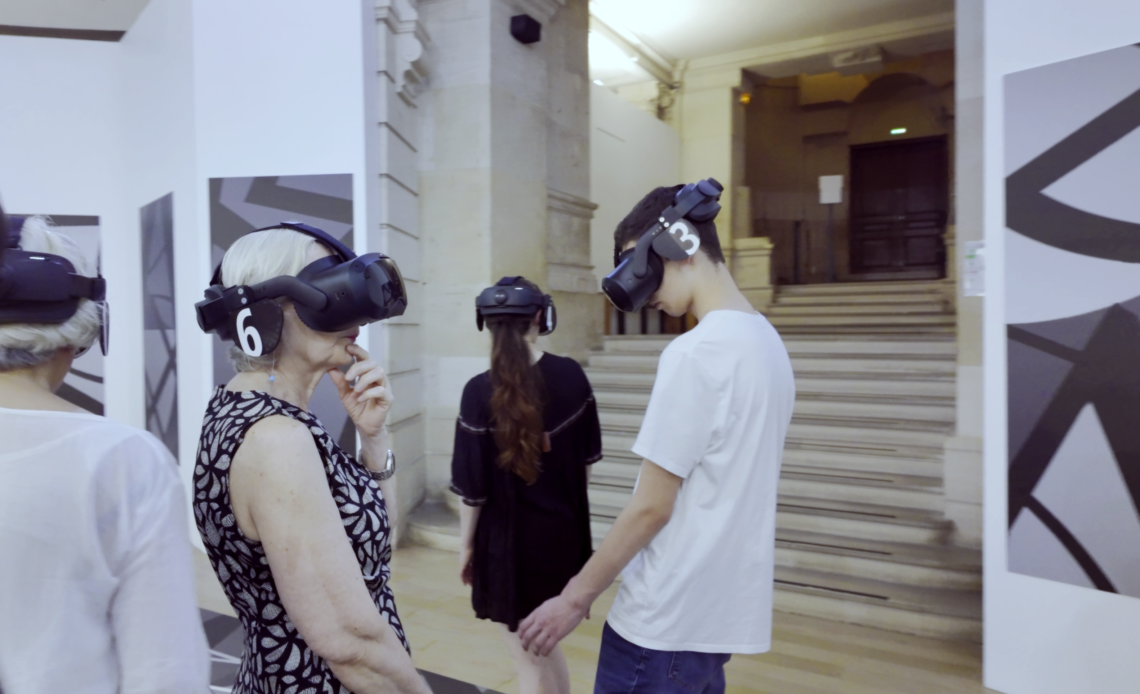
Crédits photos : © La Magie Opéra - Back Light
Summary of the second conference cycle of the 28th edition of Laval Virtual “LBE, Media & Museums”, Wednesday, April 8, 2026
The essentials: the immersive entertainment sector is moving beyond the proof-of-concept stage towards a structured industry. LBE experiences are becoming more professional, cultural institutions are embracing them at scale, and AR glasses are beginning to enter exhibition spaces. But profitability remains fragile where content is king. A sustainable business model is not yet a given.
Laval Virtual 2026: Europe’s Largest XR Event
For more than 28 years, Laval Virtual has established itself as the largest XR event in Europe. Three days of conferences, exhibitions and networking that bring together more than 5,000 visitors from 35 countries, over 150 exhibitors, and around one hundred experts on stage each year. The 2026 edition, held from April 8 to 10 at the Espace Mayenne (Laval, France), lived up to its reputation as a benchmark for the sector.
The conference programme is structured around thematic cycles. The afternoon of Wednesday, April 8 was dedicated to the “LBE, Media & Museums” cycle, focused on immersive experiences in the service of culture and entertainment. Seven presentations shed light on the entire value chain of the sector: creators, operators, studios, technology providers. The tone was that of a stocktake, not a showcase. An honest assessment of an industry still searching for its balance between artistic ambition, operational constraints, and economic viability.
The LBE Market is Set to Triple
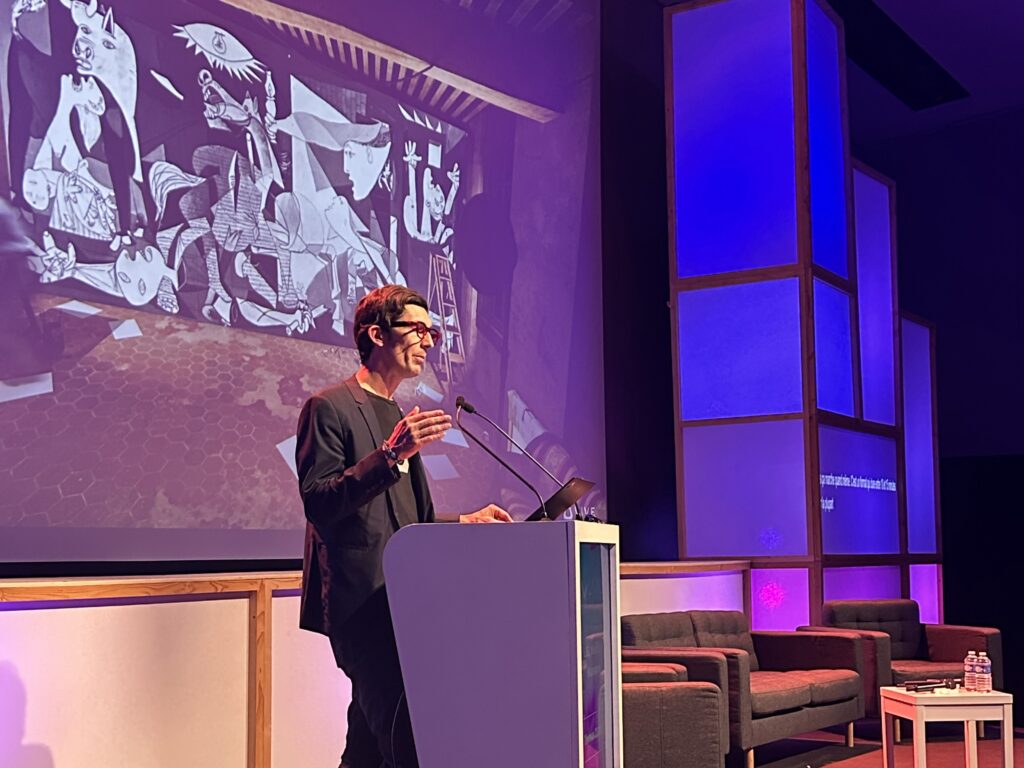
Thomas Dexmier, Vice-President Sales and Marketing EMEA at HTC Vive, opened the cycle with a frank market perspective: industry projections point to a tripling of LBE market revenue over the next ten years, from around 5 billion dollars in 2025 to 15 billion by 2034. The EMEA Vice-President began by stating what makes these experiences fundamentally valuable:
“People enjoy the combination of a real physical experience with a level of interactivity. That is exactly what XR delivers. It is different. It is unique.”
What has changed for the better, in his view, is the hardware. Wireless headsets, hot-swappable batteries, easier-to-clean interfaces. Details on the surface, but ones that radically transform the operational viability of installations and their capacity to handle continuous audience throughput.
And of course: the content. Thomas Dexmier cited several experiences developed in partnership with HTC Vive Arts: the reconstruction of the Emperor Qin mausoleum, and above all Playing With Fire, produced with Atlas V and on show at the Philharmonie de Paris until May 3, which combines a physical Steinway piano, a volumetric capture of pianist Yuja Wang, and an alternation between VR immersion and mixed reality.
During the session, he also presented Vive Eagle, the manufacturer’s first pair of AI-connected glasses. The HTC representative stressed their deliberately different positioning compared to American competitors:
“We need to do things right when it comes to user consent, privacy, and data management. Issues that major American players do not seem to be taking seriously enough, and which are creating problems for the entire category.”
He outlined a detailed use case for museums with these glasses: replacing the linear audio guide with a conversational companion that sees what the visitor sees, adapts its commentary to their profile, and whose content is entirely controlled by the institution.
AR in the Service of Inclusion Through Reading
Pamela Aculey, co-founder and CEO of MIXD Reality (UK), brought a distinctive angle to this cycle: augmenting printed books with augmented reality, motivated by inclusion. Her starting point is personal. Her son Walter, who is autistic, did not speak until the age of eight. While exploring AR on printed books with him, she observed something unexpected:
“He was no longer just looking at the page. He was trying to mimic the sounds he was hearing, repeating them, engaging with the story in a way we had never seen before.”
What MIXD Reality has built since: augmented books for primary school children (ages 4–8), tested in nearly 150 schools across the UK. Before-and-after comparisons following AR integration show up to 85% improvement in retention, focus and knowledge acquisition. Her central argument goes beyond the technical question: AR does not replace the printed page, it makes it responsive to the reader. For children who learn visually or kinaesthetically, it is a way into the story rather than an additional barrier.”The artist’s vision was to blend the visitor’s reality with the reality of his art. And the last painting in the exhibition is a portrait of you.” Parental resistance to this type of technology is real, she acknowledges, but it is fading. According to MIXD Reality, what parents want to preserve is the physical book, and what AR adds is a layer of meaning, not another screen.
Ten Years of AR Glasses and a World First at the Pompidou
Antoine Gilbert began by noting that Snap has been investing in AR for ten years, long before the subject became fashionable. The Paris AR studio, created in 2021 following the Choose France summit, has since worked with major French cultural institutions. The figures set the context: 360 million daily AR users on Snapchat, and a community of 37,500 developers on Lens Studio. The core of his presentation was a world first: the first exhibition entirely designed for the fifth-generation Spectacles, Snap’s AR glasses.
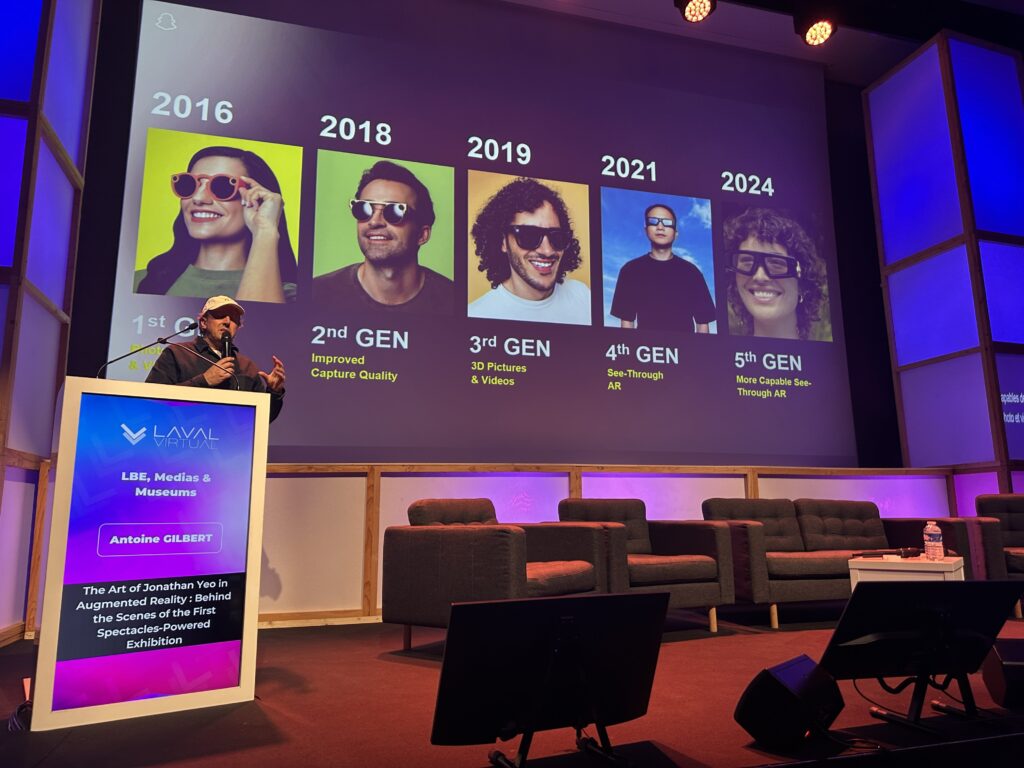
Spectacular, The Art of Jonathan Yeo in Augmented Reality was shown in 2025 at the Centre Pompidou, in New York, and at South by Southwest (Austin). The concept: visitors enter a room displaying portraits by British painter Jonathan Yeo (including his celebrated portrait of King Charles III), put on the Spectacles glasses, and experience a progressive fusion between the paintings and their own image.
“The artist’s vision was to blend the visitor’s reality with the reality of his art. And the last painting in the exhibition is a portrait of you.”
The technical setup is understated but effective: a photo of the visitor’s face is taken at the start of the visit, the glasses progressively augment each painting, and the artist guides the journey through audio. At the end of the visit, a QR code allows visitors to retrieve their digital portrait, or a physical print in some configurations. Antoine Gilbert also used the session to confirm an announcement: a new pair of consumer-facing Spectacles will be launched this year, with a wider field of view than the current developer version.
AI-Powered AR Experiences That Adapt to Each Visitor
Stefan Marx, co-founder and CEO of Zaubar (Germany), approached the cycle from a technological angle: how to make AR heritage experiences simultaneously personalised, spatially coherent, and reliable. His opening diagnosis was direct:
“AI is often not really ready for this. It is not aware of its surroundings. It is not spatially coherent. And that is the problem we are working on.”
A finding that echoes the trilemma outlined that same morning by Christian Sandor: adapting AI to the complexity of the real world remains the central challenge of the sector. Zaubar has developed two types of experiences. The first: mobile applications that allow visitors to point their phone at a painting in a museum and see it come to life, or engage in conversation with the painted characters, using an AI system trained by curators to prevent hallucinations. It was at the Kunstpalast in Düsseldorf that this approach was first deployed. The second: outdoor AR role-playing games at heritage sites, such as a castle in western Rhineland where visitors take on the role of a medieval citizen and interact with reconstructed inhabitants of the site. A “living outdoor museum”, as he put it.
What distinguishes Zaubar’s approach: the priority given to personalisation over spectacle. A system that knows the visitor, knows the place, and adapts the content accordingly. Zaubar also presented its most recent production at Laval: Presence, a reconstruction of Tunnel 57 in Berlin, through which 57 people successfully escaped under the Wall in 1964, with period witnesses reconstructed in AR.
Producing an LBE Experience: Advice From a Pioneer
Antoine Cayrol, founder and CEO of Atlas V, chose to talk not about vision but about method. After ten years producing VR experiences for the online market, Atlas V moved into location-based entertainment (LBE) three years ago. Playing With Fire is their third production in this format.
The project brings together up to 40 people in a shared space, around a Steinway Spirio piano playing on its own, its keys moving physically without a performer. The audience begins seated, headset on, in a mixed reality world: the physical space remains visible, but Yuja Wang appears as a volumetric avatar, captured at the 4DVIEWS studios in Grenoble. Moving away from the piano, the experience shifts into VR — a fully virtual world. Moving closer, it returns to mixed reality: the piano plays physically, and the pianist’s avatar appears beside it. Visitors can remain seated or move freely. Each person builds their own journey through the space.
The sound operates in three layers: the acoustic piano itself, an L-Acoustics system for ambient sound design, and personalised audio elements delivered directly through the headset depending on where one is standing. His practical advice, stated plainly:
“Start your project with a first venue already on board. Without that, you have a project, not a product. You have no figures, no photos, no proof that it works and sells tickets.”
He also stressed the choice of the lead artist as a commercial visibility lever: Yuja Wang has a massive following. Classical piano alone is not necessarily mainstream. The combination of the two opens up the market.
He also highlighted two production details worth retaining. First: the final scene of the experience is lived without a headset. Creative director Pierre-Alain Giraud wanted to give the audience a few minutes to step out of immersion, look at each other, exchange a glance or a word, before returning to the ordinary world. “I will do it again in all my future productions,” Antoine Cayrol said.
Second: the project’s financing is deliberately multi-country and multi-partner. “Don’t try to get everything from one partner or one country. The resources aren’t there. Split the funding and the revenue.” Playing With Fire is on show at the Philharmonie de Paris until May 3, 2026, then travels to Shanghai, London and Montreal in 2027.
How to Turn an Immersive Experience Into a Viable Business Model
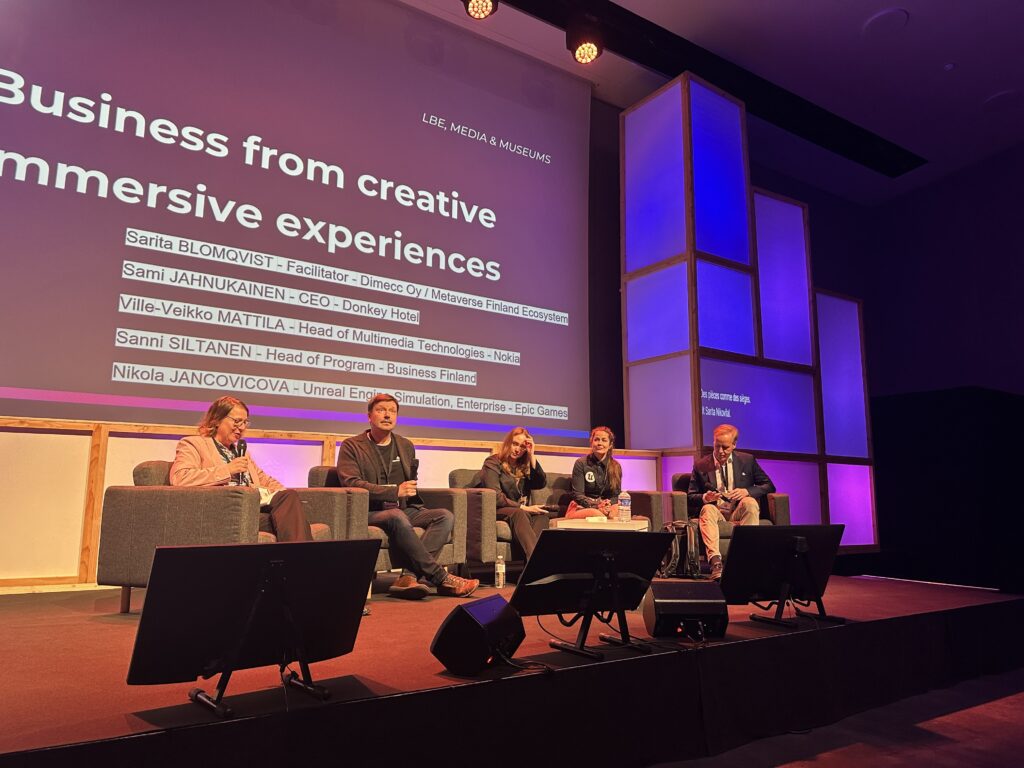
Moderated by Sanni Siltanen (Business Finland), this panel brought together Sami Jahnukainen (Donkey Hotel), Sarita Blomqvist (Metaverse Finland Ecosystem), Nikola Jancovicova (Epic Games / Unreal Engine) and Ville-Veikko Mattila (Nokia).
How do you move from creative immersive experiences to viable, scalable business models? Several answers emerged. The first: diversify revenue streams from the outset, mixing original content, commissions and creative services, as Donkey Hotel has done for ten years. The second: leverage shared technology infrastructure. Unreal Engine, for instance, powers LBE productions, defence simulations and climate modelling alike — which reduces development costs. The third, championed by Business Finland: the role of a national ecosystem is not to fund isolated demos, but to create the conditions for a structured industry capable of attracting investment and projecting itself internationally.
A conviction shared by all panellists: in this sector, the ecosystems that last are those that think industry before thinking project.
Backlight: 12 Years of VR and Two Absolute Rules
Frédéric Lecompte and Eric Barbedor, respectively CEO and Creative-Technologist at Backlight (Paris), closed the cycle with a reflection on twelve years of activity in VR and nearly 90 productions. Their conclusion rests on two principles, stated as non-negotiable rules after years of experimentation:
“VR is a visual medium. If you have to explain to people what they are supposed to feel or understand, it means the experience is not doing it on its own.”
And on the place of the audience within the experience: “Our audience members are neither quite spectators nor quite actors. We call them spect-actors. It is an accurate synthesis of our positioning.” Backlight’s trajectory illustrates the broader arc of the sector: from heavy PC VR installations in 2014 to standalone streaming experiences today, from brand content to international artistic co-productions. They closed their presentation by sharing their current projects: Enter Amsterdam (a narrative reconstruction of the city’s history in PC VR), Lady Liberty (a standalone experience for the Musée d’Orsay in September), and Guaca Odyssey (an immersive dance experience exploring Caribbean music and African heritage).
What We Take Away at Laval Virtual
Behind the diversity of presentations, the “LBE, Media & Museums” cycle surfaces several consistent findings:
- LBE culture has left the experimental stage. The Louvre, Versailles, the Paris Opera, the Musée d’Orsay, the Philharmonie, the Pompidou: major institutions have adopted LBE. The model works. The question now is one of scalability and national and international touring.
- Content remains the decisive variable. Technology has become vastly simpler to operate. What distinguishes an experience that tours the world from one that stays in a Parisian basement is narrative and artistic quality, not hardware.
- AR glasses are entering museums. Snap with Spectacles, HTC with Vive Eagle, Zaubar with its heritage applications: three different approaches, one shared direction. The VR headset is no longer the only immersive and interactive format.
- The business model remains the real challenge. It is the unspoken thread running through the entire cycle. Many fine productions, enthusiastic audiences, institutional partners. But long-term profitability, the ability to tour, to secure multi-source funding, to build stable revenue: this remains the open construction site of the entire industry.
Laval Virtual 2026 brought together nearly 5,000 visitors from 35 countries over three days of conferences and exhibitions at the Espace Mayenne, Laval, France. The “LBE, Media & Museums” cycle took place on the afternoon of Wednesday, April 8, 2026.

