



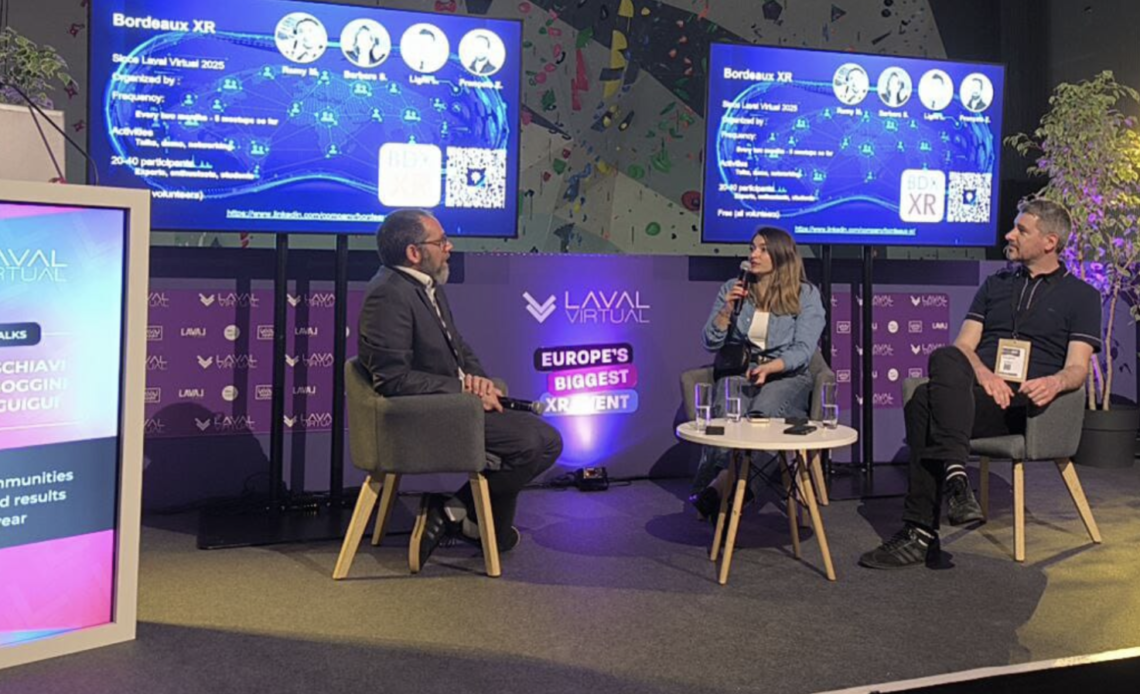
At Laval Virtual, Vincent Guigui (Paris XR), Barbara Schiavi (Bordeaux XR) and Thomas Boggini (Rennes XR) gave an honest account of a year spent building the French XR scene.
Crédits photos : © XR France
They have no budget, no legal status, and yet they bring together hundreds of professionals, students and enthusiasts around a technology that is still struggling to find its place with the general public. Barbara Schiavi (Bordeaux XR), Thomas Boggini (Rennes XR) and Vincent Guigui (Paris XR) took the floor at a roundtable to explain how, over the course of a year or two, they turned a desire to share into something that looks, almost in spite of themselves, like a movement.
Communities born in bars
The story of each of these groups begins the same way: someone tired of being alone with their passion. Thomas Boggini recalls: “I wanted to share that with the people around me. We talked about the metaverse in a bar with a few people, and since they were just as enthusiastic, we said: let’s do it again.” Rennes XR was born. Two conferences a year, between 30 and 50 attendees, and one absolute rule: it’s free, and it always will be. Over three years, six meetups organised, 120 different participants, zero euros spent.
In Paris, Vincent Guigui relaunched a group that had existed before Covid and vanished with it. “People were so grateful. They said: finally, I’m not alone in caring about XR.” Today, Paris XR welcomes 50 people every month (the maximum the venue can hold) and evenings regularly stretch past 11pm.
Bordeaux XR is the newest addition, launched in the wake of last year’s Laval Virtual, directly inspired by the Rennes and Paris model. “We wanted to see whether the momentum existed in Bordeaux too,” explains Barbara Schiavi. The answer was unambiguous: 40 people at the first event, and an unexpected success story (including a meeting between a student and an Inria research lab that turned into an internship).
A deliberately lean model
What stands out from the three organisers’ accounts is their embrace of organisational lightness. No association status, no membership fees, no sponsors. “When you don’t charge people, you don’t create expectations,” sums up Thomas Boggini. This agility is a deliberate contrast with structures like EuroXR, which has existed for more than fifteen years but whose mechanics (scientific conferences, paid memberships, formal governance) carry an administrative weight that local groups refuse to take on.
The flip side is that everything rests on the personal energy, and sometimes the personal finances, of the organisers. “We give our time, sometimes our money,” admits Barbara Schiavi, “and the question of staying motivated comes up regularly.” Vincent Guigui, who organises monthly events, puts it this way: “One event has barely ended before we’re already thinking about the next. We need to find speakers, topics. It’s draining, but the response from the audience is so strong it keeps you going.”
The glass ceiling
The question of scaling up is very much on people’s minds. Paris XR has already experimented with morning corporate formats (including at Unity’s offices) to reach a more business-oriented audience, with real success. But going further requires money. Charging participants seems out of the question: the audience is made up of students, freelancers and employees who cannot or will not pay. And sponsors require a legal entity.
That is where the idea of an umbrella association (one that would cover all local groups) comes in. XR France, the Discord and LinkedIn platform that already counts 530 members and acts as a national hub, could play that role. But practical questions pile up: who pays the insurance? Who manages memberships? How do you preserve the agility that makes the current model work?
“There are also personal liability issues,” one of the speakers pointed out. “When you organise an event, your personal responsibility is on the line. An association would provide a framework.”
A growing XR ecosystem
Beyond the three groups represented on stage, Vincent Guigui noted that the broader ecosystem has grown considerably: Lyon XR, WebXR, Nantes XR, Lille XR… each with its own format. Lille XR? Just an afterwork, no presentations, five to ten people over a drink. “There’s no universal model,” Guigui concludes. “We adapt to what the local audience wants.”
And if someone in the room wanted to launch their own group? The message is simple: “Post a meetup on LinkedIn. Give the time and place. And show up. The rest follows.”
The roundtable took place on 9 April 2026 at Laval Virtual, followed by an afterwork gathering members of the XR France communities, the CNXR (Conseil National de la XR), and WIIT (Women in Industries of Tomorrow).

